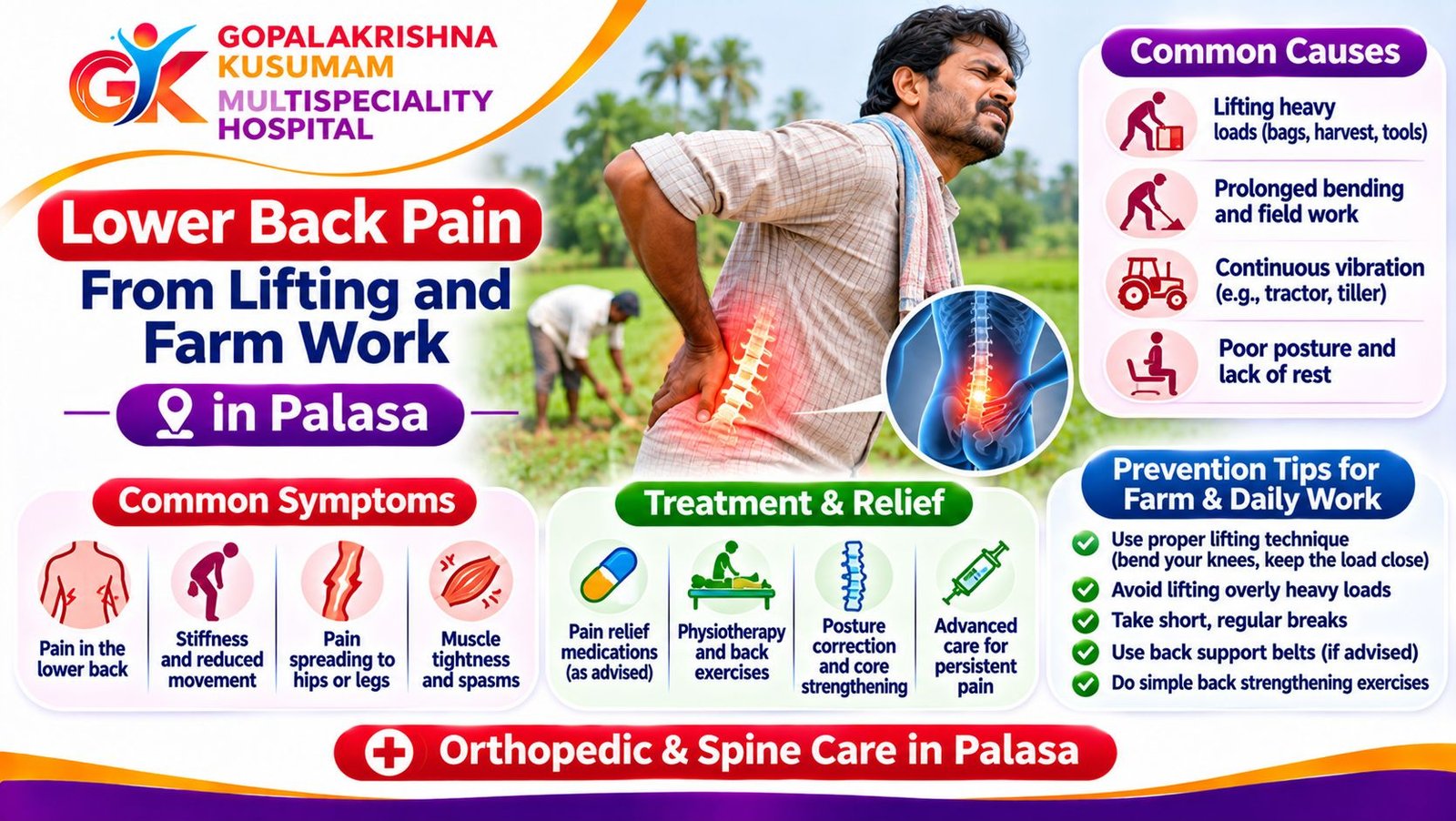
Lower Back Pain From Lifting and Farm Work in Palasa
Lower back pain from lifting and farm work: what helps and when to see a doctor
Quick answer: Most lower back pain after lifting, bending or a long day of field work is a strain of the muscles and ligaments, and it usually gets better within a few weeks. Keep gently active, avoid long bed rest, use a cold or warm pack, and lift with your back straight and the load close to your body. Get urgent help if back pain comes with numbness around the genitals or bottom, new problems passing urine or stools, weakness or numbness in both legs, chest pain, or if it started after a serious fall or road accident.
This week many families in Palasa, Kasibugga and the villages around Srikakulam district are lifting fallen branches, wet sacks, tin sheets and furniture after Cyclone Arnab. At the same time, the paddy harvest season means long hours of bending, cutting and carrying bundles, and many people in the area also lift heavy loads in cashew processing units, at the fishing harbour and in shops and godowns. It is no surprise that a sore lower back is one of the most common complaints after a week like this.
This guide explains why the lower back hurts after heavy work, what you can safely do at home, how to lift and work in a way that protects your back, and which warning signs mean you should see a doctor quickly.
Why does the lower back hurt after lifting or field work?
The lower back carries most of the upper body's weight and does much of the work when we bend, twist and lift. According to the World Health Organization (WHO), low back pain is the single leading cause of disability worldwide, and in about 90% of people it is "non-specific", which means there is no single disease or structural damage that explains it. WHO lists low physical activity, smoking, obesity and high physical stress at work among the risk factors.
Common reasons for a sore back after heavy work include:
- Muscle or ligament strain: lifting something heavy, lifting while twisting, or lifting repeatedly when tired can overstretch the soft tissues around the spine.
- Long periods of bending: working bent forward in a paddy field, over a cashew-shelling table or over a fishing net loads the lower back for hours.
- Sudden unaccustomed effort: people who do not usually do heavy work, such as office workers or students helping with cyclone clean-up, are more likely to strain their back.
- Slips and awkward falls: wet floors, mud and debris after heavy rain increase the risk of a sudden jerk to the back.
- An irritated nerve (sciatica): sometimes a disc in the lower spine presses on a nerve and causes pain, tingling or numbness that travels down one leg.
Bone problems can also play a part, especially in older adults. Weak bones from osteoporosis can lead to a spinal fracture after a minor fall or even a heavy lift; our article on osteoporosis and bone health after 40 explains who is at higher risk.
Symptoms of a simple back strain
A simple strain often causes:
- Aching or stiffness across the lower back, sometimes worse on one side.
- Pain that gets worse when you bend, lift, cough or get up from sitting, and eases when you rest in a comfortable position.
- Muscle tightness or spasm, which can make it hard to stand up straight for a day or two.
- Pain that slowly improves day by day.
WHO describes acute back pain as pain lasting less than six weeks, and chronic back pain as pain lasting 12 weeks or more. Most strains belong in the first group.
What you can do at home in the first few days
The NHS (UK National Health Service) says back pain usually improves within a few weeks and suggests these steps:
- Stay as active as you can. Gentle walking and continuing light daily activities help recovery. Long bed rest tends to make the back stiffer and slows healing.
- Use a cold or warm pack. A cold pack (ice wrapped in a cloth) can reduce pain and swelling, and a warm pack wrapped in a cloth can relieve stiffness and muscle spasm. Never put ice or a very hot object directly on the skin.
- Take simple pain relief if needed. A pharmacist or doctor can advise which over-the-counter medicine is suitable for you, especially if you are pregnant, elderly, or have kidney, stomach, heart or other health problems. Do not take pain-killer injections or strong tablets from unqualified sources.
- Do gentle stretches and exercises. Once the sharp pain settles, gentle back stretches and regular walking help the muscles recover.
- Take breaks from heavy work. Share the load with others while your back recovers, and avoid lifting heavy objects for a few days.
Be cautious with forceful massage, "bone setting" or pulling of the back by untrained people, particularly if you are older, if the pain started after a fall, or if you have leg symptoms. If the back may be injured, it is safer to get it examined first.
How to lift safely during clean-up and harvest
Many back strains can be prevented with a few simple habits:
- Plan the lift. Check the weight first, clear the path of mud and debris, and ask for help with anything heavy or awkward, such as wet mattresses, tin sheets, tree trunks or full rice bags.
- Start in a good position. Stand close to the load with your feet apart, one foot slightly forward for balance.
- Bend your knees and hips, not just your back. Keep your back as straight as you comfortably can and tighten your stomach muscles as you lift.
- Keep the load close to your body, at waist height, with the heaviest side nearest to you.
- Do not twist while carrying. Turn by moving your feet, not by twisting your back.
- Use tools and helpers. Wheelbarrows, trolleys, two-person carries and smaller loads reduce strain. Cutting fallen branches into smaller pieces before moving them is safer than dragging a whole branch.
- Take regular breaks. In field work, change position every half an hour or so, stand up, walk a little and stretch backwards gently.
For other clean-up hazards, such as falls from roofs, cuts from metal sheets and fallen electric wires, see our guide to cyclone clean-up injury safety and first aid.
Back care for people who work in fields, cashew units and fishing
Daily work in and around Palasa can put steady strain on the back. Some practical ideas:
- Paddy and field work: where possible, alternate between bending tasks and standing tasks, and share heavy bundles between two people rather than carrying them alone on the back.
- Cashew processing and sorting: sitting on a low stool for many hours can tire the back. A seat at a comfortable height, with the work at elbow level, and short standing breaks every hour may help.
- Fishing and harbour work: pulling nets and lifting fish boxes involves repeated bending and twisting. Using both arms, keeping the load close and turning with the feet all reduce strain.
- Carrying water pots or gas cylinders: use a trolley or carry smaller amounts more often, especially if you already have back pain or are pregnant.
- Two-wheeler travel on rough roads: after the rains, potholes and broken roads can jolt the back. Ride slowly and take breaks on longer trips.
General health also matters. WHO notes that being physically active, not smoking and keeping a healthy body weight are linked with lower risk of back pain.
Warning signs: when back pain is an emergency
The NHS advises calling an ambulance or going to an emergency department straight away if you have back pain together with any of these:
- Numbness or tingling around the genitals or the bottom (anus).
- New difficulty passing urine, loss of bladder control, or loss of bowel control.
- Pain, tingling, weakness or numbness in both legs.
- Chest pain along with the back pain.
- Back pain that started after a serious accident, such as a road accident or a fall from a height.
These can be signs of pressure on the nerves at the base of the spine or of a serious injury, and they need to be assessed quickly. In Palasa and Kasibugga, call 108 or 112 for an ambulance. If someone has fallen from a roof or tree and has back or neck pain, do not move them unless they are in danger; wait for trained help.
The NHS also advises urgent medical advice if back pain comes with feeling hot, cold, shivery or generally unwell, or if the pain is severe and starts suddenly or gets worse quickly.
When to see a doctor for back pain
Book an appointment with a doctor if:
- The pain is not getting better after a few weeks of home care.
- The pain stops you from doing your daily work, or you are struggling to cope with it.
- The pain does not improve with rest or is worse at night.
- The pain is worse when you sneeze, cough or pass stools.
- You have lost weight without trying.
- You notice a lump or swelling in your back, or your back has changed shape.
- The pain is in the upper back, between the shoulders, rather than the lower back.
- You have pain, tingling or numbness that travels down one leg.
- You have osteoporosis and the pain started after a small fall or lift.
What happens at an orthopaedic consultation
At a visit to the orthopaedics department, the doctor will usually ask how the pain started, what kind of work you do, and whether you have any leg symptoms or warning signs. They will examine your back, legs and nerves. Most people with a simple strain do not need a scan. Depending on what the doctor finds, they may advise:
- Pain relief suited to your health.
- A plan to return to normal activity and work step by step.
- Exercises or physiotherapy to strengthen the back and core muscles.
- An X-ray if a fracture is suspected, or an MRI or other tests if there are nerve symptoms or warning signs.
- Further treatment for specific problems such as a slipped disc or spinal fracture, if found.
Treatment depends on the cause, your age and your general health. Your doctor can explain the options, their benefits and their possible risks.
Frequently asked questions
Should I rest in bed until my back pain goes away?
No. Long bed rest usually makes back pain and stiffness worse. The NHS advises staying as active as you can, with gentle walking and normal daily activities, while avoiding heavy lifting until the pain settles. Short rests in a comfortable position are fine.
Is ice or heat better for a strained back?
Both can help. The NHS suggests a cold pack wrapped in a cloth to reduce pain and swelling, and a warm pack wrapped in a cloth to relieve stiffness or muscle spasm. Use whichever gives you more relief, and never put ice or a hot object directly on the skin.
Do I need an X-ray or MRI for back pain?
Most people with a simple back strain do not need a scan. A doctor may advise an X-ray or MRI if the pain started after a fall or accident, if there are warning signs such as leg weakness or bladder problems, or if the pain does not improve as expected.
When can I go back to field work or lifting?
Many people return to light work within days and build up gradually as the pain eases. Start with lighter loads, use safe lifting habits and take regular breaks. If heavy work still causes sharp pain after a few weeks, see a doctor before returning to full duties.
Can back pain be a sign of something serious?
Rarely, yes. Back pain with numbness around the genitals or bottom, new bladder or bowel problems, weakness or numbness in both legs, chest pain, or pain after a serious accident needs emergency care, so call 108 or 112. Feeling hot, shivery or unwell, unexplained weight loss, or pain that is worse at night also needs a doctor's check.
Contact the hospital
For an orthopaedic consultation at Gopala Krishna Kusuma Multispeciality Hospital, 3B, 5c 431/3A, Jayaramachandrapuram road, Kasibugga, Padmanabhapuram colony, Shivaji Nagar, Palasa, Andhra Pradesh 532222, call +91 79008 08790, or visit our contact page for directions and other ways to reach us. In an emergency, call 108 or 112.
Hours: OPD Monday to Saturday, 9 AM to 9 PM; emergency services 24 hours.
Disclaimer: This article is for general information only and is not a substitute for professional medical advice, diagnosis or treatment. Please consult a qualified doctor about your own health.
Image credit: madartzgraphics (Pixabay), via Wikimedia Commons, CC0. Representative stock image; it does not show the hospital's patients, staff or premises.