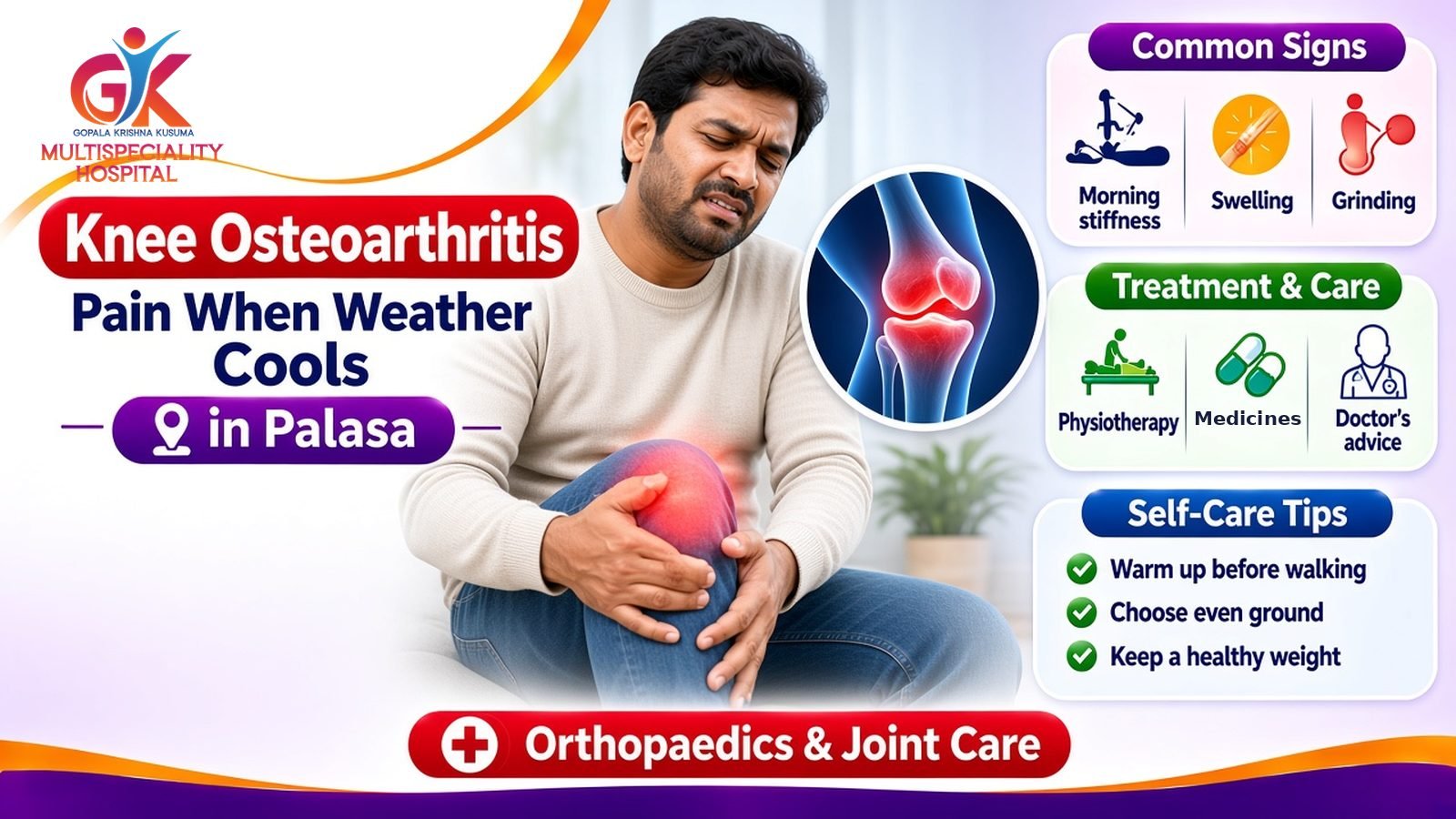
Knee Osteoarthritis Pain When Weather Cools in Palasa
Knee osteoarthritis when the weather cools: signs, self-care and when to see a doctor in Palasa
Quick answer: Knee osteoarthritis is the most common form of arthritis in the knee. The smooth cartilage that cushions the joint gradually wears away, so bone can rub on bone and the knee becomes painful and stiff. Many people notice more joint pain when the weather changes. Cooler November nights and early-winter mornings in Palasa can make morning stiffness feel worse, especially after farm or market walking. Osteoarthritis cannot be cured, but exercise, weight care, suitable footwear, medicines a doctor may advise, and sometimes injections or surgery can help manage pain and keep you moving.
In Palasa and Kasibugga, cooler November evenings and early-winter mornings, along with market walks, temple visits and long sitting at family functions, can all test the knees. People with knee wear-and-tear often notice more morning stiffness on cool days. This guide covers what knee osteoarthritis is, why weather can flare symptoms, home care, and when to seek orthopaedic help.
What is knee osteoarthritis?
According to the American Academy of Orthopaedic Surgeons (AAOS) OrthoInfo page on arthritis of the knee, arthritis is inflammation of one or more joints. Pain, swelling and stiffness are the primary symptoms. The knee is especially commonly affected.
AAOS explains that osteoarthritis is the most common form of arthritis in the knee. It is a degenerative, wear-and-tear type that occurs most often in people 50 years of age and older, although it may occur in younger people too. In osteoarthritis, the cartilage in the knee joint gradually wears away. As it becomes frayed and rough, the protective space between the bones decreases. This can result in bone rubbing on bone and produce painful bone spurs. Osteoarthritis usually develops slowly, and the pain it causes worsens over time.
The NHS (UK National Health Service) osteoarthritis page similarly describes osteoarthritis as a condition that causes joints to become painful and stiff, and says it is the most common type of arthritis in the UK. Almost any joint can be affected, but the knees, hips and small joints of the hands are often involved.
Why cooler weather can make knees feel worse
AAOS notes that many people with arthritis note increased joint pain with changes in the weather. Cool air, damp mornings after rain, and less warm-up before walking can make an already stiff knee feel tighter. In Palasa, as winter sets in, people often walk more for shopping, weddings and family visits, then sit for long meals. That mix of cooler nights, longer walks and then long sitting can flare pain even when the joint disease itself has not suddenly changed.
Weather does not cause osteoarthritis by itself. It can, however, make existing symptoms more noticeable. If pain is new, one-sided after a fall, or stops you walking, do not assume it is "just the cold" — get it checked.
Common signs of knee osteoarthritis
AAOS lists these features of an arthritic knee:
- the joint may become stiff and swollen, making it difficult to bend and straighten the knee
- pain and swelling may be worse in the morning, or after sitting or resting
- vigorous activity may cause pain to flare up
- the knee may lock or stick during movement, or creak, click, snap or grind (crepitus)
- pain may cause a feeling of weakness or buckling in the knee
The NHS lists joint pain and stiffness, problems moving the joint, and sometimes swelling, tenderness, or a grating or crackling sound when moving the joint. Severity varies greatly from person to person and between different joints. For some people symptoms are mild and come and go; for others they are more continuous and make everyday activities hard.
Who is at higher risk
The NHS notes that several things are thought to increase the risk of developing osteoarthritis, including:
- joint injury, or overusing a joint before it has healed after an injury or operation
- other joint conditions that have severely damaged a joint (sometimes called secondary arthritis)
- age — risk rises as you get older
- family history
- obesity, which puts extra strain on weight-bearing joints such as the knees
- being a woman — osteoarthritis is more common in women than men
AAOS also describes posttraumatic arthritis years after a fracture, meniscal tear or ligament injury. Farm and market work with squatting, stairs or excess weight can make wear noticeable earlier.
If you want to understand bone strength more broadly, see our guide to osteoporosis and bone health after 40 in Palasa. For pain under the heel that can also limit walking, read about heel pain and plantar fasciitis care.
How doctors usually assess the knee
AAOS explains that a doctor will take a history, examine the knee for swelling, tenderness, motion, instability and gait, and may order X-rays (which can show joint-space narrowing and bone spurs) or, less often, MRI, CT or blood tests if another arthritis is suspected.
The NHS says a GP may suspect osteoarthritis if you are 45 or older, have joint pain that worsens with use, and morning stiffness is absent or lasts under 30 minutes. Further tests are not usually necessary but may rule out other causes. Longer morning stiffness can suggest another inflammatory arthritis.
What you can do to ease cooler-weather flares
AAOS states there is no cure for arthritis, but many treatment options can help manage pain and keep people active. Initial treatment is usually nonsurgical. Practical steps that often help include:
- Stay gently active. AAOS recommends exercise for osteoarthritis to improve pain and function. Switching from high-impact activity (such as jogging) to lower-impact options (such as walking on even ground, cycling or swimming where available) puts less stress on the knee. Balance and coordination work alongside traditional exercise may help function.
- Warm up on cool mornings. Before walking to the market or temple, take a few minutes to bend and straighten the knee gently, or wrap a warm cloth around the joint for a short time if that feels comfortable.
- Watch body weight. AAOS notes that losing weight can reduce stress on the knee joint, resulting in less pain and increased function. The NHS also links excess weight with higher strain on the knees.
- Choose supportive footwear. The NHS advises wearing suitable footwear. Firm, well-fitting shoes help more than thin flip-flops on long walks over uneven roads in Kasibugga.
- Use simple supports when advised. AAOS says a cane, brace or knee sleeve can help. An "unloader" brace may shift weight away from one side of the knee; a support brace helps support the whole knee load. AAOS does not recommend shoe wedges for relieving knee discomfort.
- Heat or ice. AAOS notes that applying heat or ice, or wearing an elastic bandage for support, may provide some relief.
- Physiotherapy. Specific exercises can increase range of motion and strengthen the leg muscles. A doctor or physiotherapist can suggest a plan that fits your lifestyle.
The NHS adds that mild symptoms can sometimes be managed with regular exercise, losing weight if overweight, suitable footwear, and devices that reduce strain during daily activities. If symptoms are more severe, you may need painkillers and a structured exercise plan with a physiotherapist.
Medicines and injections a doctor may discuss
Do not start strong pain medicines on your own if you have kidney disease, stomach ulcers, heart disease or take blood thinners — ask a doctor first. AAOS explains that people respond differently to medications, so a doctor works with each person on what is safe.
- Over-the-counter non-narcotic pain relievers and anti-inflammatory medicines are often tried first for knee arthritis.
- NSAIDs (such as ibuprofen or naproxen) may be used by mouth or as a gel; oral NSAIDs can improve pain and function but should be used with caution or avoided in people with certain heart or kidney conditions.
- Acetaminophen (paracetamol) may help people who cannot take traditional NSAIDs.
- Topical NSAIDs are strongly recommended for pain control in some guidance AAOS summarises, especially if oral NSAIDs are not tolerated.
- AAOS advises that oral narcotic (opioid) medicines should be avoided for knee arthritis pain because this class is not effective for that purpose.
- Corticosteroid injections into the joint can reduce pain and inflammation for a time; effects do not last indefinitely, and doctors may limit how often they are given because of possible side effects.
Ask a doctor before taking joint supplements; AAOS notes evidence that they reverse arthritis progression is lacking.
When surgery may be considered
AAOS says a doctor may recommend surgery if arthritis pain causes disability and is not relieved with nonsurgical treatment. Options can include procedures to reshape bone (osteotomy) in selected early one-sided disease, or partial or total knee replacement when damage is more severe. Arthroscopy is not often used to treat arthritis of the knee, though it may be considered when there is also a degenerative meniscal tear. Recovery and physiotherapy needs depend on the procedure. The surgical team should explain benefits and risks for each person.
The NHS notes that in a small number of cases, when other treatments have not helped or joint damage is particularly severe, surgery may be done to repair, strengthen or replace a damaged joint.
When to get urgent or prompt help
Seek urgent care (call 108 or 112) if:
- the knee suddenly cannot bear weight after a fall or twist
- the joint looks badly deformed, or the lower leg becomes cold, numb or blue
- there is a high fever with a hot, very swollen knee
See a doctor soon if:
- knee pain keeps you awake or stops farm, market or household work for more than a couple of weeks
- the knee locks, gives way repeatedly, or swells after ordinary walking
- pain is getting steadily worse despite rest, sensible activity and simple pain relief a pharmacist or doctor has advised
For non-emergency joint problems, our orthopaedics department page lists bone and joint services available at the hospital.
Frequently asked questions
Does cold weather cause knee osteoarthritis?
No. Osteoarthritis develops from wear of the joint cartilage over time, with risk factors such as age, previous injury, family history and excess weight. AAOS notes that many people with arthritis feel more joint pain when the weather changes, so cooler Palasa nights may worsen symptoms without causing the disease itself.
Can knee osteoarthritis be cured?
No. AAOS and the NHS both explain that arthritis of this type cannot be cured. Many people still manage pain well with exercise, weight care, footwear, physiotherapy, medicines and, when needed, injections or surgery. A doctor can help choose options that fit your health and daily work.
Should I stop walking if my knees hurt in cool weather?
Usually not completely. AAOS recommends exercise for osteoarthritis and switching to lower-impact activity rather than stopping movement. Short, steady walks on even ground, after a gentle warm-up, are often better than long, rushed shopping trips. If pain is severe, the knee locks, or you cannot bear weight, stop and get checked.
Do I always need an X-ray?
Not always. The NHS says further tests such as X-rays are not usually necessary to diagnose typical osteoarthritis but may be used to rule out other problems. AAOS notes X-rays help show joint-space narrowing and bone spurs when imaging is done. Your doctor will decide based on your history and examination.
When should I ask about surgery?
Ask when pain and stiffness still limit daily life after a fair trial of exercise, weight care, footwear, physiotherapy and medicines a doctor has advised. AAOS says surgery may be considered when nonsurgical care does not relieve disability. The decision depends on the type of arthritis, your age, health and X-ray findings.
Contact the hospital
For an orthopaedic consultation at Gopala Krishna Kusuma Multispeciality Hospital, 3B, 5c 431/3A, Jayaramachandrapuram road, Kasibugga, Padmanabhapuram colony, Shivaji Nagar, Palasa, Andhra Pradesh 532222, call +91 79008 08790, or visit our contact page for directions and other ways to reach us. In an emergency, call 108 or 112.
Hours: OPD Monday to Saturday, 9 AM to 9 PM; emergency services 24 hours.
Disclaimer: This article is for general information only and is not a substitute for professional medical advice, diagnosis or treatment. Please consult a qualified doctor about your own health.
Image credit: Branded educational infographic created for this article (AI-assisted illustrative visual). It does not show the hospital's patients, staff or premises.