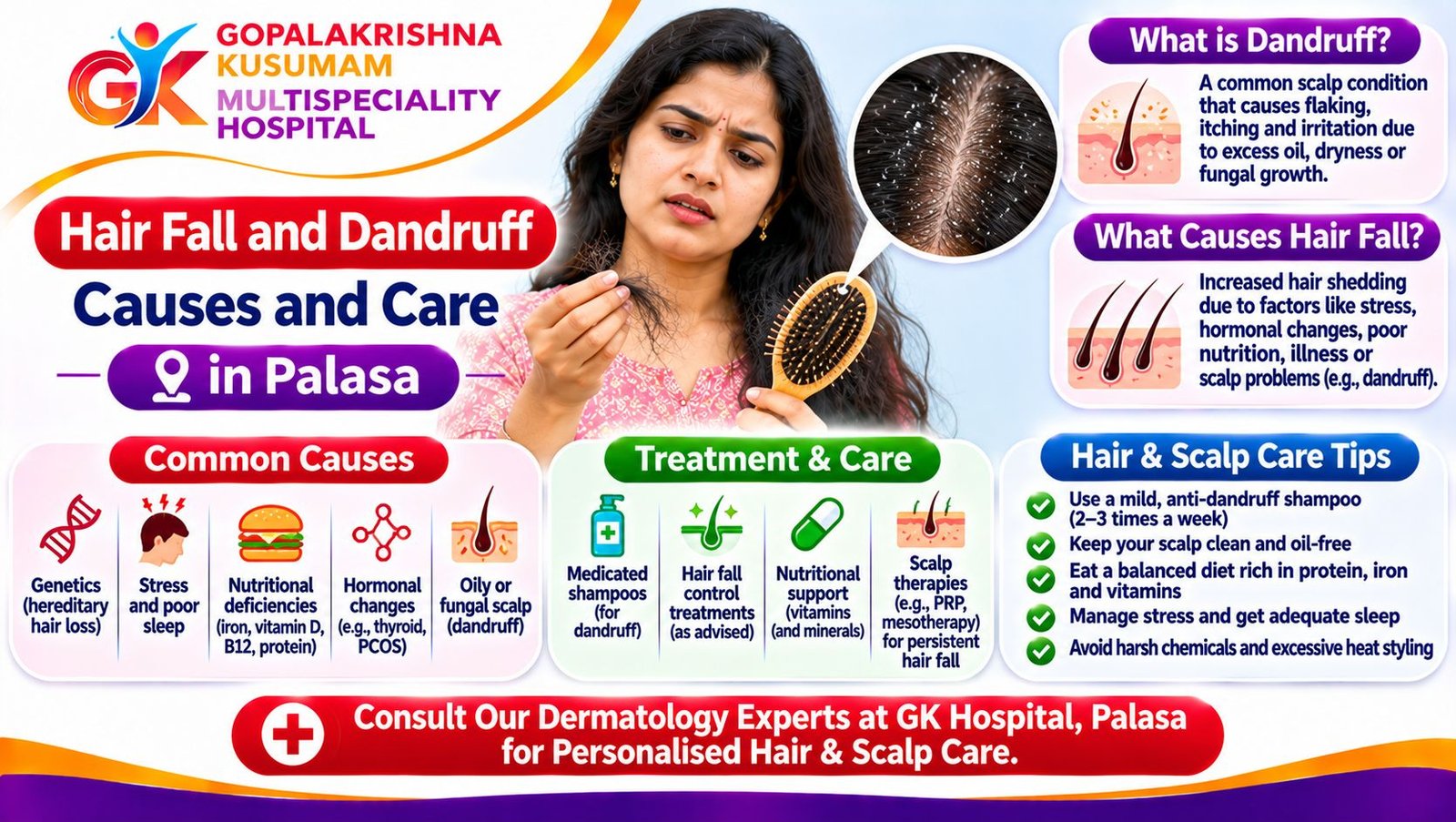
Hair Fall and Dandruff Causes and Care in Palasa
Hair fall and dandruff: common causes, home care and when to see a dermatologist
Quick answer: Losing about 50 to 100 hairs a day is normal. Heavier shedding often starts two to three months after a stressful event such as a high fever, an illness, an operation, childbirth or sudden weight loss, and it usually settles on its own. Dandruff is common, not harmful, not contagious and not caused by poor hygiene; it can usually be controlled with a suitable anti-dandruff shampoo. See a doctor if hair falls out in patches, the scalp is red, swollen, very itchy or painful, or dandruff does not improve after about 4 weeks of treatment.
After the monsoon months, many families in Palasa, Kasibugga and across Srikakulam district have been through fevers, viral infections, stress from heavy rain and storms, or simply a busy festival season. A few weeks later, some people notice more hair on the pillow, comb or bathroom floor and worry they are going bald. Others struggle with white flakes and an itchy scalp. Both problems are common, and most of the time they are manageable.
This guide explains the difference between hair shedding and hair loss, common causes of dandruff, safe home care, and when a dermatology consultation is a good idea.
How much hair fall is normal?
According to the American Academy of Dermatology (AAD), it is normal to shed between 50 and 100 hairs a day. Hair grows in cycles, and every day some hairs reach the end of their life and fall out while new hairs grow in their place. You may notice more hair after washing or oiling because loose hairs come out together.
When the body sheds significantly more hairs every day, dermatologists call it excessive hair shedding, and the medical term is telogen effluvium. This is different from true hair loss, in which something stops the hair from growing.
Hair shedding after fever, illness or stress
The AAD lists several stressors that can cause many hairs to shed at the same time:
- A high fever or recovering from an illness, such as viral fevers that are common after the rains.
- Giving birth.
- Losing a lot of weight quickly.
- Having an operation.
- Going through a lot of stress, for example after losing a loved one or facing a disaster.
- Stopping birth control pills.
An important clue is timing. The AAD explains that people often notice the shedding a few months after the stressful event. So hair fall that starts in November may be linked to a fever or stressful period back in August or September. As the body readjusts, the excessive shedding usually stops, and within 6 to 9 months the hair tends to regain its normal fullness. The AAD adds that if the stress continues, the shedding can last longer.
Hair fall after childbirth
Many new mothers notice heavy hair fall after delivery. The AAD notes that a new mother can see excessive shedding about two months after giving birth, and that it usually peaks about four months after the birth. This shedding is normal and temporary, and it is not the same as true hair loss. As the body readjusts, the shedding stops. Eating well, resting when possible and handling the hair gently can help during this time.
When hair fall may be hair loss
The AAD explains that hair loss (when hair stops growing) can have other causes, including:
- Hereditary hair loss. The AAD notes that women with hereditary hair loss may notice gradual thinning, while men tend to develop a receding hairline or a bald patch in the centre of the scalp.
- An overactive immune system. One example, alopecia areata, can cause round bald patches on the scalp.
- Some medicines and medical treatments.
- Hairstyles that pull on the hair, such as very tight plaits, buns or ponytails worn day after day.
- Harsh hair care products.
- Compulsively pulling out one's own hair.
Other health problems, such as thyroid disease, low iron levels or a fungal infection of the scalp, can also cause hair loss. A dermatologist can examine the scalp and help work out whether you have shedding, hair loss or both. If you suspect a medicine or treatment is causing hair fall, the AAD advises talking with your doctor first, because stopping some medicines suddenly can cause serious side effects.
What causes dandruff?
The NHS (UK National Health Service) describes dandruff as a common skin condition that causes white or grey flakes of dead skin to appear on the scalp and in the hair, often with itching. Key points from the NHS:
- Dandruff is not harmful and is not contagious.
- It is not caused by poor hygiene, although not washing your hair often enough can make the flakes more noticeable.
- The most common cause is a skin condition called seborrhoeic dermatitis. It may also be linked to a yeast that naturally lives on the skin, to eczema, or to a reaction to hair products.
- Stress and cold weather may make dandruff worse.
Some people mistake other scalp problems for dandruff. The NHS lists seborrhoeic dermatitis, scalp ringworm (tinea capitis), eczema, contact dermatitis (a reaction to a hair product or dye) and psoriasis as conditions that can look similar. Thick, silvery scaly patches may be psoriasis; you can read more in our guide to psoriasis symptoms, triggers and care. According to the NHS, scalp ringworm can cause a red or silver rash on the scalp, sometimes with patchy hair loss; it is a fungal infection, and our article on ringworm and fungal infection treatment explains it in more detail.
Home care for dandruff
The NHS says you can usually treat dandruff yourself with an anti-dandruff shampoo from a pharmacy or shop:
- Use an anti-dandruff shampoo. Look for one that contains an anti-fungal ingredient such as ketoconazole, or ingredients such as coal tar or salicylic acid. A pharmacist can help you choose.
- Ask how to use it. A pharmacist can tell you how to use the shampoo, for example how long to leave it on before rinsing.
- Give it time. Use the shampoo for up to 4 weeks to see if your dandruff gets better.
- Try another type if needed. You might need to try more than one type to find a shampoo that works for you.
Other simple habits may also help: wash your hair regularly and rinse well, avoid scratching the scalp hard, and try to reduce stress where you can.
Leaving heavy oil on the scalp for long periods, or applying home mixtures of lemon, camphor or other strong ingredients, can irritate the skin in some people. If your scalp burns, stings or becomes red after using a product, stop it and seek advice.
Gentle hair care habits
Simple habits may reduce breakage and help you notice changes early:
- Use a wide-toothed comb and detangle gently, starting from the ends.
- Avoid very tight plaits, buns or ponytails every day, and change your parting from time to time.
- Limit harsh chemical treatments, bleaching and very hot styling tools.
- Eat a balanced diet with enough protein, fruit and vegetables. Very strict diets and rapid weight loss can trigger shedding.
- Do not share combs or towels, especially if anyone at home has a scaly, itchy scalp.
- Be cautious with products or pills sold with promises of fast hair regrowth.
When to see a dermatologist
The NHS advises seeing a doctor about dandruff if it has not improved after using an anti-dandruff shampoo for 4 weeks, if your scalp is very itchy, red or swollen, or if you have flaky patches elsewhere on your face or body. Also consider a visit to the dermatology department if:
- Hair falls out in round patches, or you see bald areas or a fast-widening parting.
- Hair shedding continues for more than about six months.
- Your scalp is painful, has pus-filled bumps, or a child has a scaly rash with patchy hair loss.
- Hair fall comes with tiredness, weight changes, irregular periods or other new symptoms.
A dermatologist will usually ask about recent illness, childbirth, diet, medicines and hair care, and examine the scalp and hair. In some cases blood tests (for example, for thyroid function or iron levels) may be advised. Treatment depends on the cause and may include medicated shampoos, lotions or other options that the doctor will explain along with their benefits and possible side effects.
Frequently asked questions
Is losing 100 hairs a day a sign of baldness?
No, not by itself. The AAD says shedding 50 to 100 hairs a day is normal. If you are losing clearly more than usual for weeks, or you notice patches or thinning, see a dermatologist to find out the cause.
Can a fever cause hair fall months later?
Yes. A high fever or illness can cause excessive shedding, which the AAD says most people notice a few months after the event. It usually stops as the body readjusts, and hair tends to regain its normal fullness within 6 to 9 months.
Is dandruff caused by not washing hair?
No. The NHS says dandruff is not caused by poor hygiene, although washing less often can make flakes more noticeable. The most common cause is seborrhoeic dermatitis, and it may also be linked to a yeast on the skin, eczema or a reaction to hair products.
Is dandruff contagious?
No. The NHS says dandruff is not harmful and you cannot catch it. However, scalp ringworm, which can look similar, is a fungal infection, so a red or silvery scaly rash with patchy hair loss, especially in a child, should be checked by a doctor.
How long should I use anti-dandruff shampoo before seeing a doctor?
The NHS suggests using an anti-dandruff shampoo for up to 4 weeks. If you still have dandruff after at least 4 weeks, or your scalp is very itchy, red or swollen, see a doctor.
Contact the hospital
For a dermatology (skin) consultation at Gopala Krishna Kusuma Multispeciality Hospital, 3B, 5c 431/3A, Jayaramachandrapuram road, Kasibugga, Padmanabhapuram colony, Shivaji Nagar, Palasa, Andhra Pradesh 532222, call +91 79008 08790, or visit our contact page for directions and other ways to reach us. In an emergency, call 108 or 112.
Hours: OPD Monday to Saturday, 9 AM to 9 PM; emergency services 24 hours.
Disclaimer: This article is for general information only and is not a substitute for professional medical advice, diagnosis or treatment. Please consult a qualified doctor about your own health.
Image credit: Gee Hair (Flickr), via Wikimedia Commons, CC BY 2.0; cropped and resized. Representative image; it does not show the hospital's patients, staff or premises.