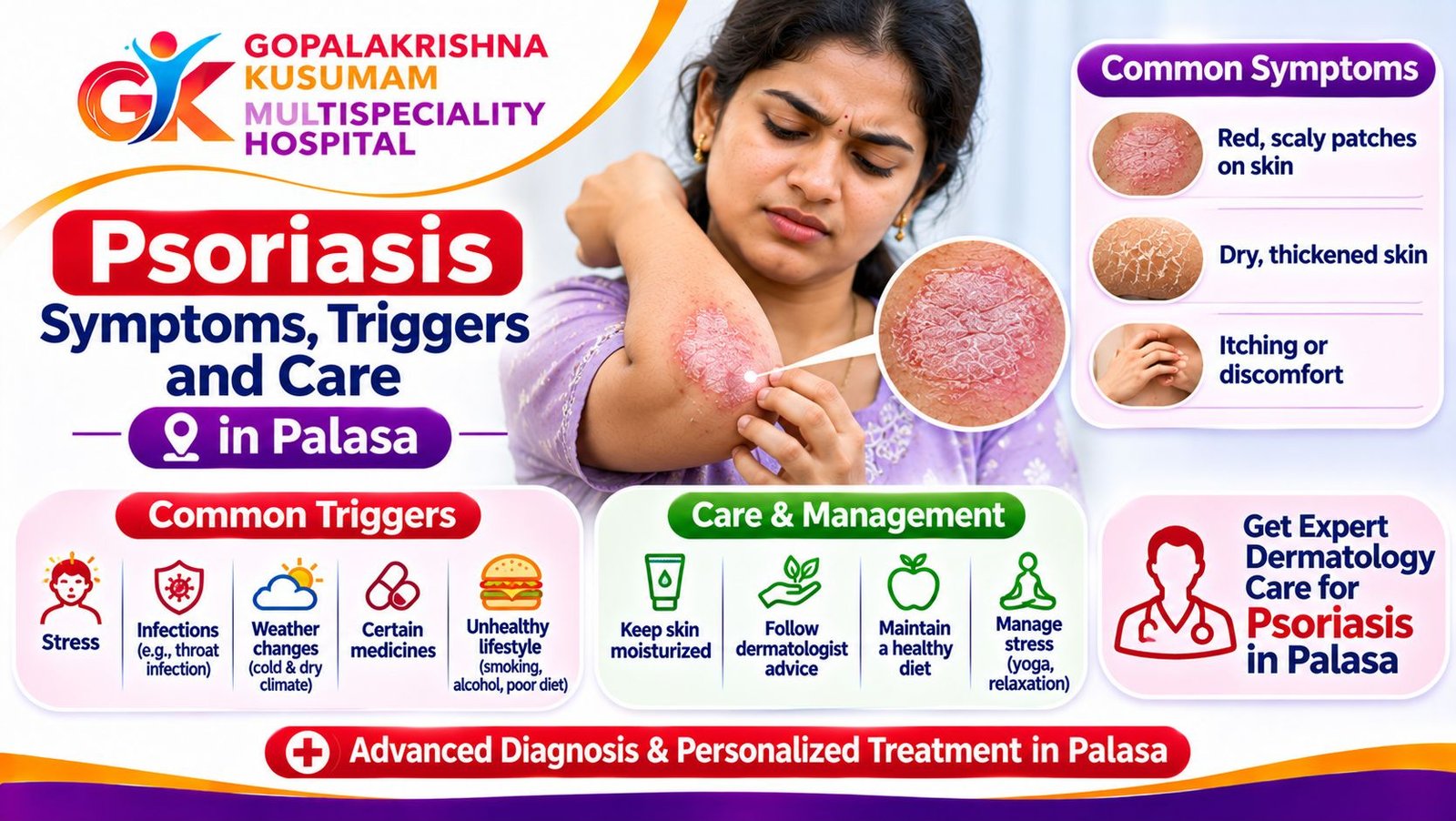
Psoriasis Symptoms, Triggers and Care in Palasa
Psoriasis: symptoms, triggers and care options
Quick answer: Psoriasis is a long-term skin condition that causes red or darker, raised, scaly patches, most often on the elbows, knees, scalp and lower back. It is not contagious and is not caused by poor hygiene. According to the NHS, there is no cure, but treatments such as creams, light therapy and tablets or injections can help control it, and common triggers include skin injury, throat infections, stress, smoking, alcohol and some medicines. See a dermatologist if a scaly rash keeps coming back, does not improve with moisturiser, or comes with joint pain or swelling.
World Psoriasis Day falls on 29 October, and this year the global campaign led by the International Federation of Psoriasis Associations (IFPA) asks people to look beyond the skin of those living with the condition. IFPA estimates that more than 100 million people worldwide live with psoriasis or psoriatic arthritis.
In Palasa, Kasibugga and across Srikakulam district, many people with psoriasis live with it for years before getting a proper diagnosis. Patches are often mistaken for a fungal infection (tamara) or eczema and treated with whatever cream is available at the local medical shop. Some people hide their skin because of worry about what neighbours or relatives will think. This guide explains what psoriasis is, how to recognise it, what makes it flare, the treatment options a dermatologist may discuss, and practical steps that help day to day.
What is psoriasis?
Psoriasis happens when the immune system becomes overactive and the skin replaces its cells much faster than normal. Instead of shedding gradually over weeks, new skin cells build up within days and form thick, scaly patches. It tends to come and go in cycles, with periods when the skin is fairly clear and times when it flares.
The NHS notes that psoriasis can start at any age, but it most often appears in people aged between 15 and 25 or between 50 and 60. It often runs in families, but not everyone with a family history develops it. Men and women are both affected.
Two points are important for families to understand. First, psoriasis cannot be passed on by touch, sharing food, towels or living in the same house. Second, it is not caused by dirt or poor washing. Children and adults with psoriasis should not be kept away from school, work, temples or family functions because of their skin.
Common symptoms and where they appear
Symptoms vary from person to person and can be mild or widespread. Look for:
- Raised patches with a clear edge, covered with silvery-white scales. On brown skin the patches may look purple, dark brown or grey rather than red.
- Itching, burning or soreness in the patches.
- Dry skin that can crack and sometimes bleed, especially over the knuckles and elbows.
- Thick scaling on the scalp that looks like severe dandruff and may extend past the hairline.
- Nail changes, such as small pits, yellow or brown discolouration, thickening or nails lifting away from the nail bed.
- Patches in skin folds such as the armpits, groin or under the breasts that look smooth and red rather than scaly.
The elbows, knees, scalp and lower back are the most typical places, but psoriasis can appear anywhere, including the palms and soles, where it may be mistaken for cracked heels or hand eczema.
Types of psoriasis
- Plaque psoriasis: the most common type, with raised scaly patches.
- Scalp psoriasis: scaling and itching on the scalp, sometimes with temporary hair shedding.
- Nail psoriasis: pitting and discolouration of finger and toe nails.
- Guttate psoriasis: many small drop-shaped spots across the body, often appearing suddenly after a throat infection, especially in children and young adults.
- Inverse psoriasis: smooth red patches in skin folds, which can be worse with sweating and friction.
- Pustular psoriasis: pus-filled spots, usually on the palms and soles, which are not infectious.
- Erythrodermic psoriasis: a rare form where most of the skin becomes red, hot and peeling. This needs urgent medical care.
Psoriasis or fungal infection: why the difference matters
Fungal infections are very common in the hot, humid climate of coastal Andhra Pradesh, so it is natural to assume that any itchy, scaly ring is tamara. But the two conditions need very different treatment. Fungal patches usually have a raised edge with clearer skin in the centre and spread outwards, while psoriasis patches are thicker, evenly scaly and often appear on both sides of the body in the same places.
Using unprescribed combination creams that contain strong steroids is a particular problem. These creams may seem to help at first, but they can make fungal infections spread, thin the skin, cause stretch marks, and make psoriasis flare when they are stopped suddenly. If a rash keeps returning, is not clearly improving after two weeks of a medical-shop cream, or you are not sure what it is, it is better to have it examined by a dermatologist. Sometimes a simple skin scraping test or, rarely, a small skin biopsy helps confirm the diagnosis.
Common triggers that can cause a flare
Many people notice that certain things set off their psoriasis. According to the NHS, common triggers include:
- Injury to the skin, such as a cut, scrape, insect bite, sunburn or even a tight strap, where new patches can appear on the injured area.
- Infections, such as a strep throat infection.
- Stress.
- Smoking and drinking alcohol.
- Living with obesity.
- Pregnancy.
- Certain medicines. Never stop a prescribed medicine on your own; ask your doctor if you think one is affecting your skin.
Weather can also play a part. Many people find their skin gets drier and itchier in the cooler, drier winter months, while heavy sweating in humid weather can irritate patches in skin folds. Keeping a simple diary of flares can help you and your doctor spot your own triggers.
Psoriatic arthritis: do not ignore joint pain
Some people with psoriasis develop psoriatic arthritis, a condition that causes pain, stiffness and swelling in the joints. It can affect the fingers and toes, knees, ankles, lower back and the places where tendons attach to bone, such as the heel. A whole finger or toe may swell up like a sausage. Morning stiffness that lasts more than half an hour is another clue.
Psoriatic arthritis can develop before, at the same time as, or years after skin symptoms, and the severity of the skin does not always match the joints. Early assessment matters because treatment can help reduce joint damage over time. If you have psoriasis and notice joint pain or swelling, mention it to your dermatologist, who may also involve an orthopaedic or rheumatology specialist.
Treatment options a dermatologist may discuss
Psoriasis cannot be cured, but in many people it can be controlled well enough to keep the skin clear or nearly clear for long periods. Treatment depends on the type, how much of the body is affected, which areas are involved, and how much it affects daily life. Options include:
- Emollients (moisturisers): used every day, they reduce dryness, scaling and itching and help other treatments work better.
- Prescription creams and ointments: such as steroid creams of the right strength for the area, vitamin D-based preparations, and medicated scalp applications and shampoos. Using them exactly as advised helps reduce side effects.
- Phototherapy: controlled exposure to specific types of ultraviolet light under medical supervision, for wider areas that do not respond to creams.
- Tablets or injections: for more severe or widespread psoriasis or psoriatic arthritis, medicines that calm the immune system may be advised. These need regular check-ups and blood tests.
Your doctor will explain the expected benefits, possible side effects and how long each treatment may take to work. Results differ between people, and it is normal to try more than one option before finding what suits you.
Living well with psoriasis: everyday tips
- Apply a plain, fragrance-free moisturiser generously at least twice a day, especially after bathing.
- Bathe with lukewarm rather than very hot water, use a mild soap or soap substitute, and pat the skin dry.
- Soften thick scalp scales with a doctor-advised oil or medicated shampoo instead of scratching or combing them off.
- Try not to scratch or pick at patches, as injury can create new ones. Keep nails short.
- Wear loose, soft cotton clothing in humid weather.
- Stop smoking and cut down on alcohol.
- Stay active, keep a healthy weight and find ways to manage stress, such as walking, yoga or talking to someone you trust.
- Take your treatment regularly, even when the skin looks better, unless your doctor advises a change.
Psoriasis can affect confidence, sleep and mood. If you feel low, anxious or are avoiding people because of your skin, say so at your appointment. That is part of your care too.
When to see a dermatologist in Palasa
Book a skin consultation if you have a scaly rash that keeps coming back, scalp scaling that does not settle with ordinary shampoo, nail pitting or thickening, a rash that has not improved with medical-shop creams, or psoriasis together with joint pain. Seek urgent care if your skin suddenly becomes red and peeling over most of the body, you develop many pus-filled spots with fever or feel very unwell, or if a patch becomes hot, swollen and painful, which may mean infection.
The dermatology department at Gopala Krishna Kusuma Multispeciality Hospital provides care for long-term skin conditions, including psoriasis, eczema and fungal infections, for adults and children. You can request an appointment online.
Frequently asked questions
Is psoriasis contagious?
No. Psoriasis cannot spread from one person to another through touch, sharing food, clothes or towels, or living together. It is caused by an overactive immune system, not by an infection or poor hygiene.
Can psoriasis be cured permanently?
No, there is currently no cure for psoriasis. However, treatments can help control symptoms, and many people have long periods when their skin is clear or nearly clear. Be cautious of any product or advert that claims otherwise.
How can I tell psoriasis from a fungal infection?
Fungal patches often have a raised edge with a clearer centre and spread outwards, while psoriasis patches are thicker, evenly scaly and often appear in the same places on both sides of the body. The two can look similar, so a dermatologist's examination, and sometimes a skin scraping test, is the reliable way to tell.
Does food affect psoriasis?
There is no single diet that clears psoriasis. A balanced diet, a healthy weight, avoiding smoking and limiting alcohol can support your overall health and may help some people. Avoid cutting out whole food groups without medical advice.
Can children get psoriasis?
Yes. Psoriasis can start in childhood, and guttate psoriasis often appears in children and young adults after a throat infection. A child with a new widespread rash should be seen by a doctor.
Is psoriasis linked to joint pain?
It can be. Some people with psoriasis develop psoriatic arthritis, which causes joint pain, stiffness and swelling. If you have psoriasis and notice these symptoms, tell your doctor early.
Contact the hospital
For a dermatology (skin) consultation at Gopala Krishna Kusuma Multispeciality Hospital, 3B, 5c 431/3A, Jayaramachandrapuram road, Kasibugga, Padmanabhapuram colony, Shivaji Nagar, Palasa, Andhra Pradesh 532222, call +91 79008 08790, or visit our contact page for directions and other ways to reach us. In an emergency, call 108 or 112.
Hours: OPD Monday to Saturday, 9 AM to 9 PM; emergency services 24 hours.
Disclaimer: This article is for general information only and is not a substitute for professional medical advice, diagnosis or treatment. Please consult a qualified doctor about your own health.
Image credit: Moose Photos (Pexels), via Wikimedia Commons, CC0. Representative stock image; it does not show the hospital's patients, staff or premises.