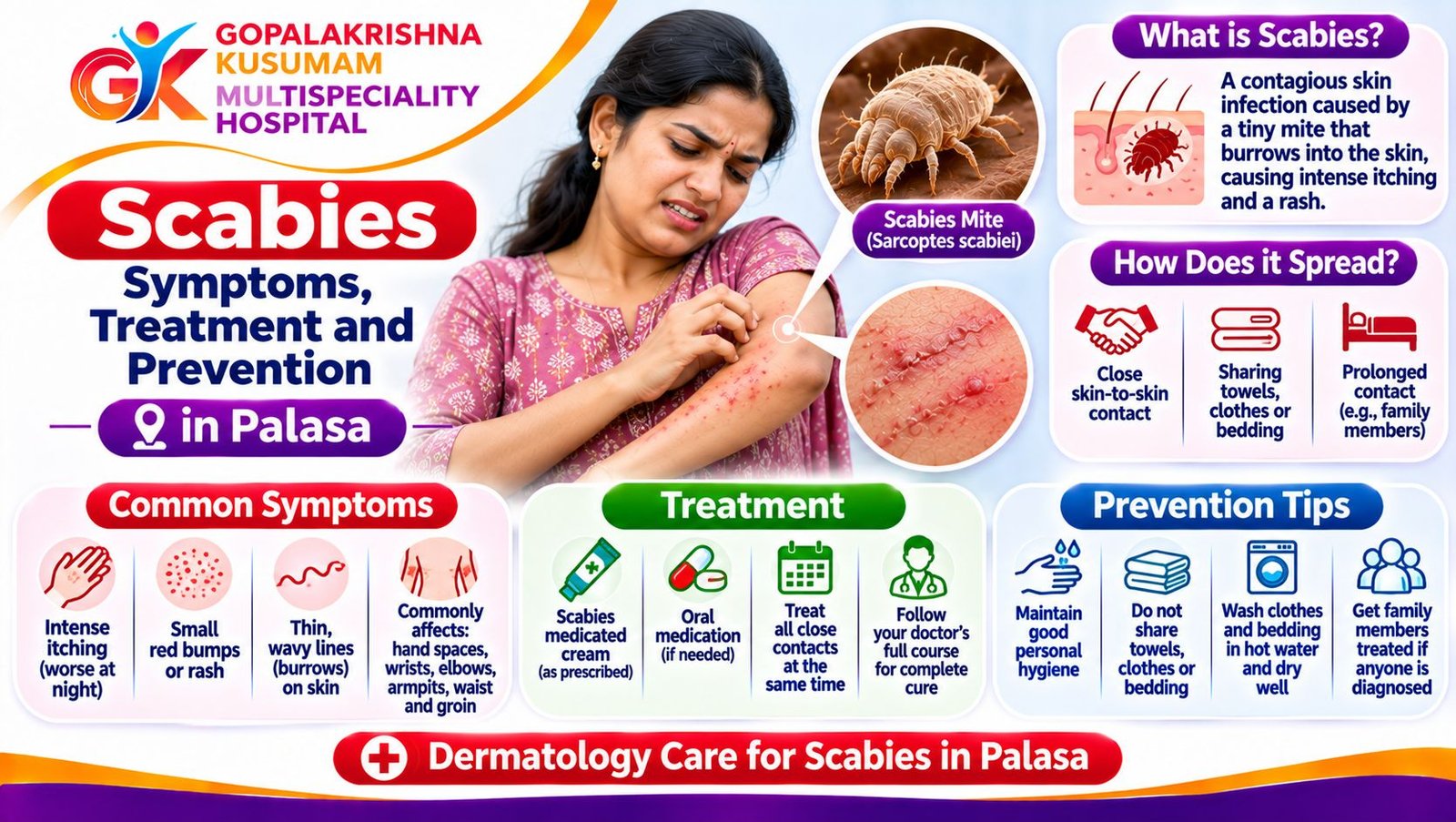
Scabies Symptoms, Treatment and Prevention in Palasa
Scabies: symptoms, treatment and how to stop it spreading at home
Quick answer: Scabies is an itchy skin rash caused by tiny mites that burrow into the skin. It spreads through close skin-to-skin contact, so it often passes between people who share a home, a bed or a crowded shelter. The main signs are intense itching, usually worse at night, and small spots or lines between the fingers, around the wrists, waist and groin. It needs treatment with a prescribed cream or lotion, used by everyone in the household at the same time and repeated after 7 days, along with hot washing of bedding and clothes. Anyone can get scabies; it has nothing to do with poor hygiene.
After Cyclone Arnab, many families in Srikakulam district spent nights in relief camps, cyclone shelters or a relative's house, with many people sleeping close together. The World Health Organization (WHO) notes that scabies is most common in hot, tropical countries and in areas of high population density, and that outbreaks occur in health institutions and vulnerable communities. As the weather turns cooler in Palasa and Kasibugga, families also tend to share blankets and beds more often. Because the itch can take weeks to appear, a rash that starts in November may have been picked up during these crowded days.
This article explains how to recognise scabies, how it differs from fungal infection and eczema, how it is treated, and what the whole family can do to stop it coming back.
What causes scabies?
Scabies is caused by a tiny mite called Sarcoptes scabiei, which is too small to see clearly with the naked eye. The female mite burrows into the top layer of skin and lays eggs. WHO explains that the eggs hatch in 3 to 4 days and the mites grow into adults in 1 to 2 weeks. The intense itch and rash come from the body's allergic reaction to the mites and their waste.
Scabies spreads mainly through prolonged, close skin contact, such as sharing a bed, holding hands for a long time, caring for a young child, or sexual contact. With common scabies, WHO says catching it from clothes and bed linen is unlikely, but this becomes more important with the severe "crusted" form. According to the NHS (UK National Health Service), you cannot get scabies from pets.
Scabies is not a sign that a family is unclean. Anyone can get it, including people who bathe every day. Feeling ashamed sometimes makes families delay treatment, which only gives the mites more time to spread.
Common symptoms of scabies
The NHS and WHO describe these typical signs:
- Intense itching, which is often much worse at night and can disturb sleep.
- A raised rash or small spots. On brown skin the spots can be harder to see, but you may be able to feel them. The rash can leave darker marks on the skin.
- Thin, wavy lines (burrows) a few millimetres long, sometimes with a dot at one end.
- Typical places: between the fingers, around the wrists, the elbows, under the arms, around the waist and belt area, the groin and the buttocks. Itchy bumps can also appear on the genitals in men and around the breasts in women.
- In babies, young children and older people, the rash can also appear on the palms, soles of the feet, ankles, head and neck.
A key clue is that several people in the same house start itching around the same time. The NHS says it can take up to 8 weeks for the rash to appear after catching scabies, and WHO says symptoms usually begin 4 to 6 weeks after infestation. During this time a person can still pass it on without knowing.
Crusted scabies: a severe form
People with a weakened immune system, some older people and people living with HIV can develop crusted (Norwegian) scabies. WHO describes thick, dry, scaly, crusted areas on the skin, often on the hands, feet, elbows and knees, which may not itch much. This form contains very large numbers of mites, spreads very easily, and can be life-threatening. It needs prompt medical care.
Scabies, fungal infection or eczema: how to tell the difference
Itchy skin is very common in our humid coastal climate, and several conditions can look alike:
- Scabies: itching worse at night, small spots and burrows between the fingers, wrists, waist and groin, and often more than one family member affected.
- Fungal infection (ringworm or "tamar"): usually ring-shaped, scaly patches with a clearer centre, often in the groin, under the breasts, at the waist or between the toes. Our article on ringworm and fungal infection treatment explains these in detail.
- Eczema: dry, rough, itchy patches, often on the inner elbows, behind the knees or on the hands, and frequently linked to allergies or dry winter weather.
Using the wrong treatment can make things worse. Steroid creams or mixed "itch creams" bought without a prescription may hide the rash for a while but do not kill the mites, and they can make fungal infections spread. If you are not sure what the rash is, see a doctor before buying creams.
How is scabies diagnosed?
WHO notes that scabies is usually diagnosed by a doctor looking at the skin: the pattern of itching, the burrows and the places affected. Sometimes a doctor may look more closely with a magnifying device or take a gentle skin scraping to look for mites under a microscope, but in most cases this is not needed.
How is scabies treated?
Scabies does not go away on its own and needs proper treatment. WHO lists several creams and lotions that are applied to the whole body, such as permethrin, benzyl benzoate or sulphur ointment, and an oral medicine (ivermectin) for some cases. WHO notes that oral ivermectin should not be taken by pregnant women or by children who weigh less than 15 kg. A doctor will choose the treatment based on age, pregnancy, breastfeeding and other health conditions.
The NHS gives these important points about treatment:
- Apply it to the whole body. The cream or lotion usually goes on all of the skin, including the scalp and face but avoiding the area around the eyes, and stays on for the time stated on the instructions.
- Repeat it after 7 days. The treatment does not kill all the eggs, so a second application a week later is needed to kill newly hatched mites.
- Treat everyone at the same time. Everyone living in the home, and close contacts, should be treated on the same day, even if they have no itching yet.
- Children under 2 need a doctor. Do not use pharmacy treatments on babies and toddlers under 2 years without medical advice. Tell your doctor or pharmacist if you are pregnant or breastfeeding.
It is normal for itching to continue for a few weeks after successful treatment, because the skin is still reacting to dead mites. WHO notes the itch often gets worse for 1 to 2 weeks after treatment starts. A doctor may suggest a soothing moisturiser or an anti-itch medicine for this. Do not keep repeating the scabies treatment on your own, as overuse can irritate the skin.
Stopping scabies from spreading at home
Treating the skin is only part of the job. On the first day of treatment, the NHS and WHO advise:
- Wash bedding, towels and clothes used in the last few days in hot water (the NHS suggests 60°C or higher where possible). After washing, dry them well in strong, direct sunlight, which WHO lists as one way to dry them.
- Seal items that cannot be washed, such as blankets, soft toys or school bags, in a closed plastic bag for at least 3 days (NHS) or up to a week (WHO). The mites usually die within 2 to 3 days away from human skin.
- Sweep and clean the rooms after treatment, especially sleeping mats and mattresses.
- Avoid sharing beds, towels and clothes, and avoid close physical contact, until treatment has been completed.
- School and work: the NHS says adults and children aged 5 or over can return to work or school once treatment has started, while avoiding close contact for the first 24 hours. Children under 5 can go back to nursery or pre-school 24 hours after the first treatment.
Hostels, residential schools, old-age homes and shared rooms for workers are places where scabies can spread from person to person. If one person is diagnosed, others in close contact should be checked and treated together.
Complications of scabies
Scratching breaks the skin and lets bacteria in. The NHS lists impetigo, a bacterial skin infection with sores and yellow crusts, as a complication, and notes that scabies can make eczema or psoriasis worse. WHO adds that in tropical settings infected scabies sores can lead to deeper infections and are linked with kidney problems in children. Keeping nails short and getting early treatment help to reduce these risks.
When to see a doctor
See a doctor at the dermatology department or another qualified doctor if:
- You think you or your child has scabies, so that the diagnosis can be confirmed and the right treatment chosen.
- A baby or child under 2 years has an itchy rash, or someone in the house is pregnant or breastfeeding.
- The skin looks infected: sores with pus or yellow crusts, spreading redness, swelling, pain or fever.
- Someone has thick, crusted, scaly patches, especially an older person or someone with a weak immune system.
- You already have eczema or another skin condition and the itching has become worse.
- The itching is still there 2 to 4 weeks after finishing treatment, or new burrows appear.
Frequently asked questions
Is scabies caused by poor hygiene?
No. The NHS says anyone can get scabies and it has nothing to do with poor hygiene. It spreads through close skin contact, which is why it often passes between family members, roommates and people sleeping close together in shelters or hostels.
Why does scabies itch more at night?
Night-time itching is one of the typical features of scabies described by the NHS and WHO. Warmth under a blanket and fewer distractions can make the itch feel stronger, and scratching while asleep can break the skin. Short nails help reduce damage from scratching.
Do all family members need treatment even if they are not itching?
Yes. Because symptoms can take weeks to appear, people may already have mites before they start itching. The NHS and WHO advise treating everyone in the household at the same time, even if they have no symptoms, to stop the mites passing back and forth.
Can I get scabies from my dog or cat?
The NHS says you cannot get scabies from pets. Animals can get a different mite condition called mange, but this is not the same as human scabies. If your pet has skin problems, consult a veterinary doctor.
Why am I still itching after scabies treatment?
Itching can continue for a few weeks after successful treatment while the skin settles. If it lasts more than 2 to 4 weeks after finishing treatment, if new burrows appear, or if the skin looks infected, see a doctor, as you may need a second check or a different treatment.
Contact the hospital
For a dermatology (skin) consultation at Gopala Krishna Kusuma Multispeciality Hospital, 3B, 5c 431/3A, Jayaramachandrapuram road, Kasibugga, Padmanabhapuram colony, Shivaji Nagar, Palasa, Andhra Pradesh 532222, call +91 79008 08790, or visit our contact page for directions and other ways to reach us. In an emergency, call 108 or 112.
Hours: OPD Monday to Saturday, 9 AM to 9 PM; emergency services 24 hours.
Disclaimer: This article is for general information only and is not a substitute for professional medical advice, diagnosis or treatment. Please consult a qualified doctor about your own health.
Image credit: el cajon yacht club, via Wikimedia Commons, CC BY 2.0; cropped and resized. Representative stock image; it does not show the hospital's patients, staff or premises.