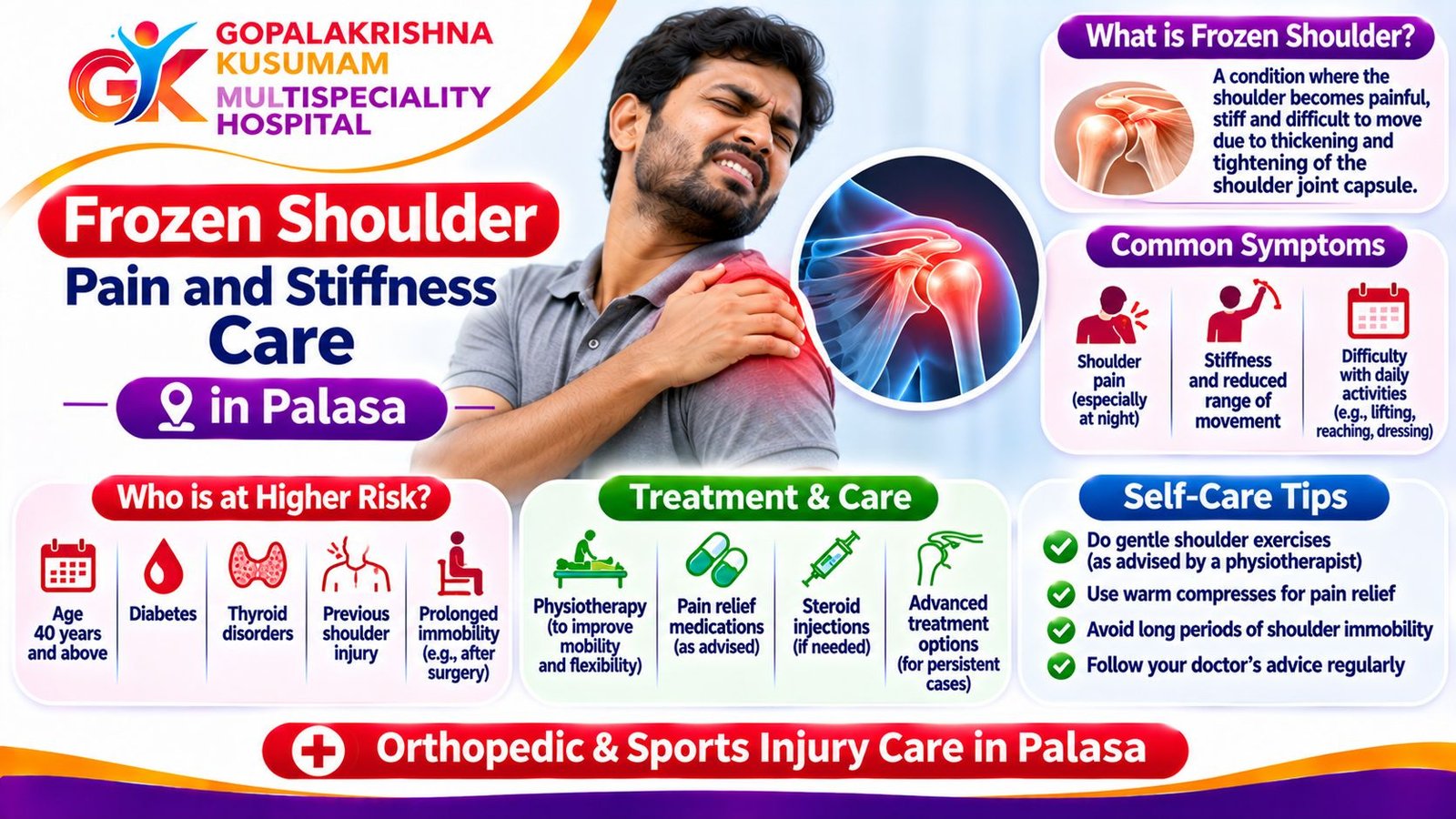
Frozen Shoulder Pain and Stiffness Care in Palasa
Frozen shoulder: symptoms, stages, home care and when to see a doctor
Quick answer: Frozen shoulder (adhesive capsulitis) is a condition in which the tissue around the shoulder joint becomes inflamed, thick and tight, causing pain and stiffness that make it hard to lift or turn the arm. It is more common between the ages of 40 and 60, in women, and in people with diabetes or thyroid problems. It usually improves slowly over months to a few years. Gentle movement, heat, simple pain relief and guided exercises help most people. See a doctor if shoulder pain and stiffness do not go away, or if the pain makes it hard to move your arm.
Many people in Palasa, Kasibugga and the villages of Srikakulam district put up with a "catch" in the shoulder for weeks, thinking it is just a sprain from lifting or from sleeping on one side. When the arm slowly stops reaching the top shelf, the back of a blouse or the back pocket, it may be frozen shoulder. With World Diabetes Day on 14 November, it is also a good time to know that diabetes is one of the main risk factors.
This guide explains what frozen shoulder is, how it differs from other shoulder problems, the three stages, what you can safely do at home, and what an orthopaedic consultation may involve.
What is frozen shoulder?
The shoulder is a ball-and-socket joint. The head of the upper arm bone sits in a shallow socket in the shoulder blade, and a strong layer of connective tissue, called the shoulder capsule, surrounds the joint. According to the American Academy of Orthopaedic Surgeons (AAOS) OrthoInfo, in frozen shoulder this capsule thickens and becomes stiff and tight, thick bands of tissue called adhesions form, and there is often less of the natural lubricating fluid in the joint. The result is pain and a shoulder that is hard to move, either on your own or when someone else tries to move it for you.
The NHS (UK National Health Service) explains that it is often not clear why people get a frozen shoulder, and that it can take months or years to get better, although the pain and stiffness usually go away eventually.
Who is more likely to get frozen shoulder?
Frozen shoulder can happen to anyone, but AAOS lists some groups at higher risk:
- Age 40 to 60: it most commonly affects people in this age group.
- Women: it occurs more often in women than in men.
- People with diabetes: frozen shoulder occurs much more often in people with diabetes. The reason is not known, and the stiffness may last longer before it starts to ease.
- Thyroid and other conditions: an underactive or overactive thyroid, Parkinson's disease and heart disease have also been linked with it.
- A shoulder kept still for a long time: after a fracture, an operation or another injury, holding the arm in one position for weeks can lead to frozen shoulder. This is one reason doctors encourage early, safe movement after injury.
AAOS notes there is no clear link with which arm you use most or with your type of work. So a frozen shoulder is not a sign that you have "worn out" your shoulder by working in the fields, a cashew unit or at the harbour.
Symptoms of frozen shoulder
The NHS describes two main symptoms:
- Pain in the shoulder, which can be worse at night and disturb sleep. AAOS describes it as usually dull or aching, felt over the outer shoulder and sometimes the upper arm, and worse when you move the arm.
- Stiffness, which makes it difficult to move the shoulder. Everyday tasks such as combing your hair, tying a sari or blouse, wearing a shirt, reaching a shelf, drawing water or getting onto a two-wheeler can become hard.
A key feature is that the shoulder is stiff whether you try to move it yourself or someone else gently moves it for you. In many other shoulder problems, such as some tendon injuries, the arm may be weak or painful but another person can still move it further.
The three stages of frozen shoulder
AAOS describes frozen shoulder as developing in three stages:
- Stage 1, freezing: pain slowly increases and the shoulder gradually loses movement. This stage typically lasts anywhere from 6 weeks to 9 months.
- Stage 2, frozen: pain may actually improve, but the stiffness remains. During these 4 to 6 months, daily activities may be very difficult.
- Stage 3, thawing: movement slowly improves. A return to normal or close to normal strength and motion typically takes anywhere from 6 months to 2 years.
Overall, AAOS says frozen shoulder generally gets better over time without surgery, although full recovery may take up to 3 years. Knowing these stages helps you plan work and home life and avoid giving up on exercises too early.
Frozen shoulder and diabetes
Because frozen shoulder is more common in people with diabetes, the NHS advises that people with diabetes keep up their regular diabetes check-ups. AAOS adds that if you have diabetes and your blood sugar control (HbA1c) is high, working with your doctor to improve sugar control can help speed up recovery of a frozen shoulder. AAOS also notes that, although uncommon, frozen shoulder can come back, especially if a contributing factor such as diabetes is still present.
If you have shoulder stiffness and have never had your blood sugar checked, ask your doctor whether a sugar test is advisable for you.
What you can do at home
The NHS suggests these steps to ease pain from frozen shoulder:
- Keep the shoulder moving gently. Keeping it completely still can make the pain worse. Avoid movements that cause sharp pain and move the shoulder only gently at first.
- Use heat. A heat pack or hot water bottle wrapped in a cloth on the shoulder for up to 20 minutes at a time may ease pain and stiffness. Never put a very hot object directly on the skin.
- Take simple pain relief if needed. A pharmacist or doctor can advise which medicine is suitable for you, especially if you are older, pregnant, or have kidney, stomach, heart or other health problems. Avoid injections or strong tablets from unqualified sources.
- Follow exercises from a doctor or physiotherapist. Do not make up your own strenuous exercises; for example, gym equipment can make the pain worse.
Be careful with forceful massage, "bone setting" or pulling of the arm by untrained people. A stiff, painful shoulder after a fall may also be a fracture or dislocation, so get it examined first. Our guide on sprain or fracture signs after a fall explains the warning signs.
Gentle stretches doctors may suggest
AAOS gives examples of stretches that are often part of a home programme. Ask your doctor or physiotherapist how many repetitions are right for you before starting:
- Doorway stretch (external rotation): stand in a doorway, bend the elbow of the affected arm to a right angle with the hand on the door frame, and gently turn your body away. Hold for about 30 seconds, relax and repeat.
- Lying arm lift (forward flexion): lie on your back with legs straight and use the good arm to lift the affected arm overhead until you feel a gentle stretch. Hold for about 15 seconds and slowly lower.
- Cross-over arm stretch: gently pull one arm across your chest just below the chin as far as you can without pain. Hold for about 30 seconds, relax and repeat.
Warmth before stretching may help the shoulder loosen. Stretch to a gentle pull, not to sharp pain.
When to see a doctor for shoulder pain
The NHS advises seeing a doctor if:
- You have shoulder pain and stiffness that does not go away.
- The pain is so bad that it is hard to move your arm and shoulder.
Also get your shoulder checked if the pain began after a fall, accident or heavy lift, if the shoulder looks deformed or swollen, if you have a fever with a hot, red joint, or if you have weakness, numbness or tingling in the arm. Shoulder or arm pain together with chest pain, breathlessness or sweating can be a sign of a heart problem: call 108 or 112 straight away.
What happens at an orthopaedic consultation
At a visit to the orthopaedics department, the doctor will usually ask when the pain started, about any injury, and about diabetes, thyroid or heart problems. AAOS explains that the doctor will gently move your shoulder in all directions and compare this with how far you can move it yourself. In frozen shoulder, both are limited.
An X-ray may be advised to rule out other causes such as arthritis. MRI or ultrasound are not needed to diagnose frozen shoulder, but they may help find other problems, such as a rotator cuff tear.
Depending on your symptoms and stage, a doctor may discuss:
- Pain relief suited to your health, used for a short period.
- Physiotherapy with stretching and range-of-motion exercises. The NHS says a course usually lasts at least 6 weeks.
- A steroid injection into the shoulder joint to reduce pain and inflammation.
- Hydrodilatation, in which a large volume of sterile fluid is gently injected into the shoulder joint to stretch the capsule, if other non-surgical measures have not helped.
- Rarely, if symptoms do not improve with these treatments, manipulation under anaesthesia or keyhole (arthroscopic) release of the tight capsule.
Every treatment has benefits and possible risks. AAOS notes that even after surgery some stiffness can remain, and people with diabetes often have some continued stiffness, so physiotherapy is still needed afterwards. Your doctor can explain which options suit you.
Frequently asked questions
Will a frozen shoulder get better on its own?
In most people it improves slowly over time. AAOS says frozen shoulder generally gets better without surgery, although full recovery may take up to 3 years. Pain relief, heat and guided exercises can make the wait easier and help movement return.
Should I rest my arm in a sling until the pain settles?
Usually not. The NHS advises keeping the shoulder moving gently, because keeping it still can make the pain worse. Avoid sudden or forceful movements and follow the exercises your doctor or physiotherapist gives you. If the pain started after a fall or injury, get it checked before exercising.
Is frozen shoulder linked to diabetes?
Yes. AAOS says frozen shoulder occurs much more often in people with diabetes, and the stiffness may last longer. The reason is not known. Keeping up regular diabetes check-ups and working on blood sugar control with your doctor is advised.
Is heat or ice better for frozen shoulder?
The NHS suggests a heat pack or hot water bottle wrapped in a cloth on the shoulder for up to 20 minutes at a time. Warmth before gentle stretching may also help the shoulder loosen. Never put a hot object directly on the skin.
Can frozen shoulder come back?
It is uncommon, but AAOS notes that frozen shoulder can come back, especially if a contributing factor such as diabetes is still present. Regular check-ups, good sugar control if you have diabetes, and keeping the shoulder gently active can help you notice early stiffness and seek advice in time.
Contact the hospital
For an orthopaedic consultation at Gopala Krishna Kusuma Multispeciality Hospital, 3B, 5c 431/3A, Jayaramachandrapuram road, Kasibugga, Padmanabhapuram colony, Shivaji Nagar, Palasa, Andhra Pradesh 532222, call +91 79008 08790, or visit our contact page for directions and other ways to reach us. In an emergency, call 108 or 112.
Hours: OPD Monday to Saturday, 9 AM to 9 PM; emergency services 24 hours.
Disclaimer: This article is for general information only and is not a substitute for professional medical advice, diagnosis or treatment. Please consult a qualified doctor about your own health.
Image credit: Spooriak, via Wikimedia Commons, CC BY-SA 4.0; Persian labels replaced with English, white margins added and resized; this adapted image is shared under the same licence. Representative image; it does not show the hospital's patients, staff or premises.