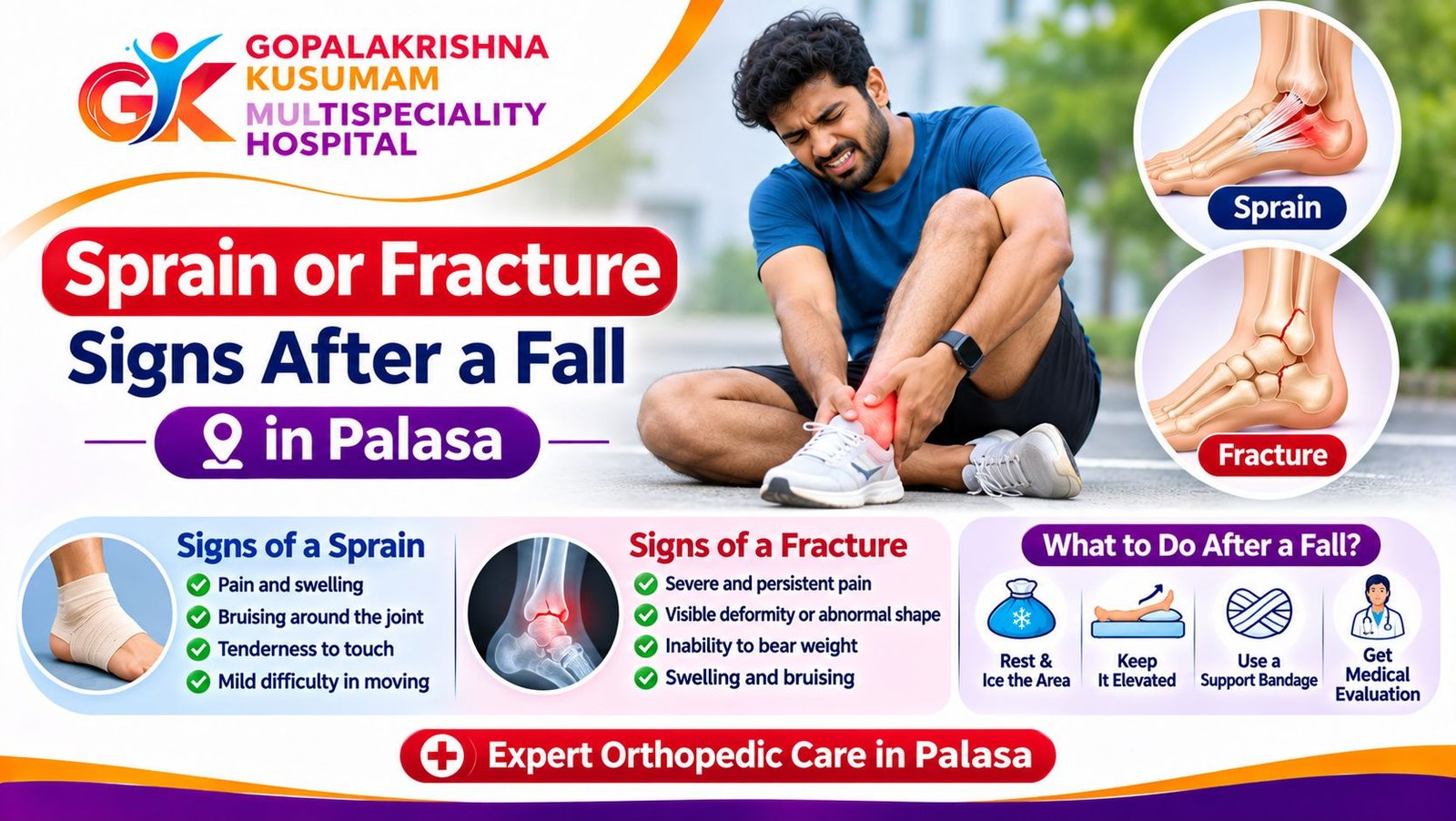
Sprain or Fracture Signs After a Fall in Palasa
Sprain or fracture: how to tell the difference
Quick answer: A sprain is a stretch or tear of the ligaments around a joint, while a fracture is a break in the bone, and the two can look very similar in the first few hours. Mild sprains usually improve with rest, ice, a light compression bandage and keeping the limb raised. Get an X-ray quickly if you heard a crack, the joint looks bent or out of shape, you cannot put weight on it or walk more than a few steps, or the fingers or toes feel numb, look blue or feel cold.
In Palasa, Kasibugga and the villages of Srikakulam district, twisting injuries are part of everyday life. A foot slips off the edge of an uneven road, someone misses a step on wet stairs, a farmer turns an ankle on a muddy field bund, or a child lands badly while playing cricket on rough ground. In the rainy and cyclone season, slippery floors, fallen branches and debris during clean-up add to the risk. Most of these injuries are sprains, but some are fractures that need proper treatment to heal straight.
The difficulty is that a sprain and a fracture can look and feel almost the same at first. Both cause pain, swelling and bruising. This guide explains the difference, the warning signs that point towards a broken bone, safe first aid you can do at home, the common mistakes to avoid, and when you should come in for an examination and an X-ray.
Sprain, strain and fracture: what is the difference?
These three words are often used loosely, but they mean different things:
- Sprain: an injury to a ligament, the tough band that holds two bones together at a joint. The ankle, wrist, knee and thumb are the most commonly sprained joints.
- Strain: an injury to a muscle or the tendon that attaches a muscle to bone, for example a pulled calf or back muscle.
- Fracture: a crack or break in a bone. It can be a small hairline crack or a complete break where the pieces move out of place.
The American Academy of Orthopaedic Surgeons explains that ankle sprains range from a mild stretch of the ligament (grade 1), to a partial tear (grade 2), to a complete tear (grade 3), and that the symptoms of a severe sprain can be similar to those of a broken bone (AAOS OrthoInfo: Sprained Ankle). That is why a doctor's examination matters when the injury is more than mild.
Signs that suggest a sprain
A typical sprain causes:
- Pain around the joint, which is worse when you move it or put weight on it.
- Swelling and bruising that develop over a few hours.
- Some difficulty using the joint, but you can usually still stand or walk a few steps, even if it hurts.
- Tenderness over the soft tissue rather than one sharp spot on the bone.
Mild sprains often feel better within a couple of weeks. The NHS notes that most people feel better after about two weeks, but that you should avoid strenuous exercise such as running for up to eight weeks because there is a risk of further damage (NHS: Sprains and strains).
Warning signs that point to a fracture
No list can replace an examination, but these signs make a broken bone more likely and mean you should get checked the same day:
- You heard a crack or snap at the time of the injury.
- The ankle, wrist or finger looks bent, out of shape or points at an odd angle.
- A bone is sticking out through the skin, or there is a deep cut over the injured area.
- You cannot put any weight on the leg, or cannot walk more than a few steps.
- Severe pain that is not easing, or pain directly over one spot of bone.
- Swelling or bruising that is large or getting worse.
- Numbness, tingling, or fingers or toes that look blue, grey or white or feel cold.
- Fever, or feeling hot and shivery after the injury, which can suggest infection.
The NHS advises that if you have a bad cut, a bone sticking out, an odd-shaped joint, severe pain, or numb or blue toes after an ankle injury, you need emergency care rather than waiting (NHS: Broken ankle).
Why an X-ray matters
An X-ray is the simplest way to see whether a bone is broken and how badly. A doctor will first examine the joint, press gently over specific points on the bones and check whether you can bear weight, and then decide whether an X-ray is needed. Not every twisted ankle needs one, but when the warning signs above are present, guessing is not safe.
Missing a fracture can cause real problems. A broken bone that is treated as a simple sprain may heal in the wrong position, leading to long-term pain, stiffness or arthritis in the joint. Some small fractures, for example in the wrist bones or the base of the little toe, are easy to miss without an X-ray.
Early diagnosis is a theme across all bone and joint problems, and you can read more in our article on how early diagnosis can help manage orthopedic conditions.
Safe first aid at home: PRICE
For a suspected mild sprain, the NHS recommends the PRICE approach for the first two to three days (NHS: Sprains and strains):
- Protection: protect the injured area from further harm, for example by using a support or wearing proper footwear.
- Rest: stop the activity and rest the joint as much as you can.
- Ice: hold an ice pack or a bag of frozen peas wrapped in a thin towel on the area for up to 20 minutes every two to three hours. Never put ice directly on the skin.
- Compression: wrap a bandage around the joint to support it and limit swelling. It should be firm but never tight.
- Elevation: keep the injured limb raised on a pillow, ideally above the level of the heart, as much as possible.
Simple painkillers such as paracetamol can help. Ibuprofen gel or tablets are another option for some people, but check with a doctor or pharmacist first if you are pregnant, older, have stomach ulcers, kidney disease, asthma or are on blood thinners.
If you suspect a fracture rather than a sprain, the NHS advises keeping the limb still, not putting weight on it, removing rings, anklets or toe rings before the swelling increases, and not eating or drinking in case you need a procedure (NHS: Broken ankle). Support the limb with a folded towel or cardboard as a temporary splint and get to a hospital.
Common mistakes to avoid
Well-meaning advice can sometimes make an injury worse. In the first two to three days:
- Do not massage the joint hard or rub it with hot oil. Heat and massage can increase swelling and bleeding inside the tissues.
- Do not apply hot water fomentation in the first couple of days. Use cold instead.
- Do not tie a tight bandage or splint for long hours without checking it. If the fingers or toes go numb, pale or blue, loosen it at once.
- Do not let anyone pull or twist the joint to "set" it before an X-ray has been done. If the bone is broken, this can move the pieces further out of place.
What treatment may involve
Treatment depends on what the examination and X-ray show:
- Mild to moderate sprains: PRICE, a support bandage or ankle brace, gradual return to walking, and simple exercises to restore movement, strength and balance.
- Severe sprains: a short period in a boot or brace, physiotherapy, and occasionally further tests if the joint stays unstable.
- Fractures: depending on the type of break, this may be a special boot, a plaster cast or slab, moving the bones back into position under anaesthetic, or surgery to fix the bones. The NHS notes that a broken ankle usually takes about six to eight weeks to heal, and sometimes longer.
Your doctor will explain how much weight you can put on the limb and whether you need crutches in the meantime.
Getting back on your feet and preventing repeat injuries
Once pain and swelling settle, gentle movement is important, because a joint kept still for too long becomes stiff and weak. The AAOS points out that repeated ankle sprains can lead to long-term ankle instability, and that strengthening, balance training, warming up before sport and wearing supportive shoes help prevent them (AAOS OrthoInfo: Sprained Ankle).
Simple steps that help at home and work:
- Wear footwear with a good grip, especially on wet floors and during the rains. Worn-out rubber chappals slip easily.
- Keep bathrooms and steps dry, add a handrail or grab bar where older family members need support, and keep a light on at night.
- Watch your step on broken roads, field bunds and debris after storms, and avoid carrying heavy loads that block your view of the ground.
- Warm up before games, and do not return to sport until you can walk, hop and turn without pain.
- Older adults with weak bones should ask their doctor about bone health, as a simple fall can cause a fracture.
When to see an orthopaedic doctor in Palasa
Please come for an examination if:
- Any of the fracture warning signs above are present.
- You cannot bear weight on the leg, or cannot use the hand properly.
- Swelling and pain are not improving after two to three days of home care.
- The joint still feels weak, unstable or keeps giving way after a few weeks.
- The injured person is an older adult, a young child, has diabetes, or takes blood thinners.
Our orthopaedics department in Kasibugga, Palasa examines bone, joint and injury problems and is within reach of Palasa, Kasibugga, Mandasa, Vajrapukotturu, Tekkali and nearby villages. You can book an appointment online or call the hospital. For a serious injury with heavy bleeding, a bone through the skin, or a head injury, call 108 or 112 for an ambulance and do not wait.
Frequently asked questions
How can I tell if my ankle is sprained or broken?
You cannot always tell without an examination and an X-ray. A crack heard at the time of injury, a joint that looks out of shape, being unable to walk more than a few steps, pain over one spot on the bone, or numb or blue toes all make a fracture more likely and need same-day medical attention.
Should I use ice or heat on a sprain?
Use ice, not heat, in the first two to three days. Wrap an ice pack or frozen peas in a thin towel and hold it on the area for up to 20 minutes every two to three hours. Heat, hot oil massage and fomentation can increase swelling early on.
How long does a sprain take to heal?
Many mild sprains feel better in about two weeks, but ligaments take longer to regain full strength. The NHS advises avoiding strenuous exercise such as running for up to eight weeks. Severe sprains and fractures take longer and need a doctor's guidance.
Can I walk on a sprained ankle?
If the sprain is mild and you can walk with only mild pain, short careful walks with a support are usually fine after the first day or two. If you cannot put weight on the foot or can only manage a few steps, stop and get it checked, as it may be a fracture.
Is it safe to get a sprain massaged or set by a local bonesetter?
Hard massage, pulling or tight traditional splints before an X-ray can make a hidden fracture worse or cut off blood flow. It is safer to get the injury examined and X-rayed first, and then follow the treatment and exercises advised by a qualified doctor.
When is a twisting injury an emergency?
Call 108 or 112, or go to a hospital immediately, if a bone is sticking out, there is a deep wound or heavy bleeding, the limb is badly bent, the pain is severe, or the fingers or toes are numb, pale, blue or cold.
Contact the hospital
For an orthopaedic consultation at Gopala Krishna Kusuma Multispeciality Hospital, 3B, 5c 431/3A, Jayaramachandrapuram road, Kasibugga, Padmanabhapuram colony, Shivaji Nagar, Palasa, Andhra Pradesh 532222, call +91 79008 08790, or visit our contact page for directions and other ways to reach us. In an emergency, call 108 or 112.
Hours: OPD Monday to Saturday, 9 AM to 9 PM; emergency services 24 hours.
Disclaimer: This article is for general information only and is not a substitute for professional medical advice, diagnosis or treatment. Please consult a qualified doctor about your own health.
Image credit: Ben Schumin, via Wikimedia Commons, CC BY-SA 2.0; cropped and resized. Representative stock image; it does not show the hospital's patients, staff or premises.