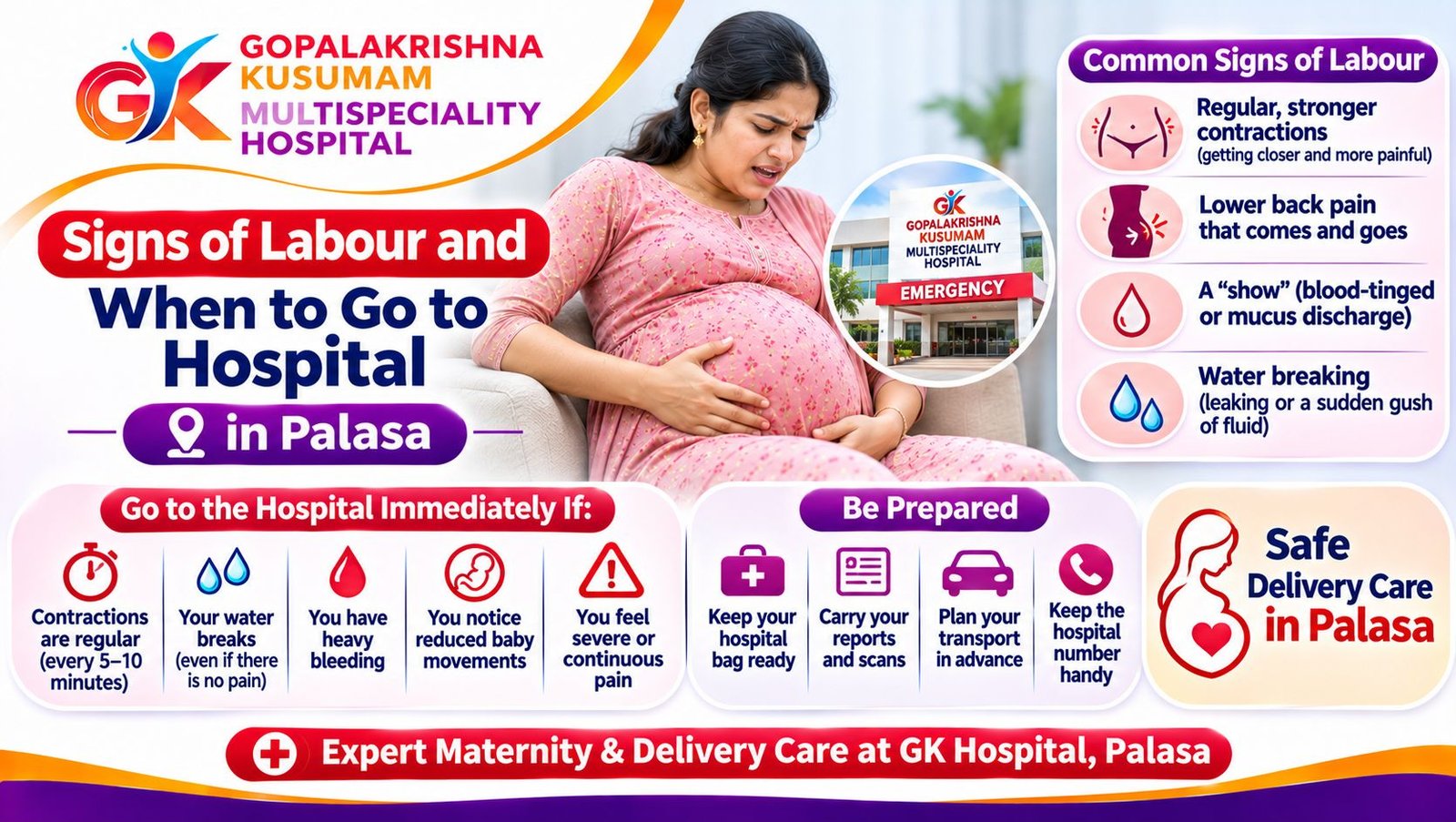
Signs of Labour and When to Go to Hospital in Palasa
Signs of labour: when to call and when to go to hospital
Quick answer: Labour usually begins with regular contractions that get stronger, longer and closer together, sometimes with a "show" of pinkish mucus, backache or your waters breaking. The NHS advises contacting your maternity team when contractions are regular and coming about every five minutes, or if your waters break. Go to hospital straight away, or call 108, if you have any bleeding, your waters are green, brown or smelly, your baby is moving less than usual, you are less than 37 weeks pregnant, or contractions last longer than two minutes or come more than five times in ten minutes.
For families in Palasa, Kasibugga and the villages around Srikakulam district, knowing when to leave for hospital is not only about the signs of labour. It also means thinking about distance, transport at night, and the weather. This week, with Cyclone Arnab bringing heavy rain to coastal Andhra Pradesh, health teams across the state have been identifying women close to their due date and helping high-risk mothers reach hospitals early, according to news reports quoting the state health department. Even outside cyclone season, monsoon rain, flooded roads and power cuts can make a short journey take much longer.
This guide explains the early signs of labour, how to tell real contractions from practice ones, the warning signs that need urgent attention, what to pack in your hospital bag, and how to make a simple plan with your family so that you are not deciding everything in a hurry.
Early signs that labour may be starting
Every pregnancy is different, and labour can start slowly over hours or even a day or two. According to the NHS, signs that labour may be starting include:
- Contractions or tightenings: your tummy becomes hard and then relaxes. In labour, these come regularly and become stronger, longer and closer together.
- A "show": the plug of mucus that seals the cervix comes away, and you may see a small amount of sticky, pinkish or jelly-like discharge.
- Backache or a heavy, aching feeling, similar to period pain.
- An urge to go to the toilet, caused by the baby's head pressing on the bowel.
- Your waters breaking: a sudden gush or a slow trickle of fluid from the vagina.
Having a show does not always mean labour will start immediately; it can be a few days away. Many women also feel tired, restless or have loose motions in the days before labour.
Real contractions or practice contractions?
Many women feel tightenings in the later months of pregnancy that are not labour. These practice contractions, often called Braxton Hicks contractions, are usually irregular, do not get closer together, and often ease when you change position, walk or rest.
Labour contractions are different. They:
- Come at regular intervals that slowly get shorter.
- Become stronger and last longer, often 30 to 60 seconds or more.
- Do not go away when you rest, walk or change position.
- Often start in the back and spread to the front of the tummy.
Time your contractions from the start of one to the start of the next and note how long each lasts. Writing this down or noting it on your phone helps your doctor or nurse understand how labour is progressing when you call.
When to call your maternity team or go to hospital
For most women, especially in a first pregnancy, early labour can go on for many hours, and it is often more comfortable to stay at home in the early stage. The NHS advises contacting your maternity team when contractions are regular and coming every five minutes or more often. Your doctor may give you different advice depending on your pregnancy, how far you live from the hospital and whether this is your first baby.
For families who live far from Palasa or Kasibugga, or where transport is uncertain, it is sensible to discuss with your doctor during antenatal visits when you should start the journey. Leaving a little earlier is usually wiser than waiting until contractions are very close together, particularly at night or in heavy rain.
When your waters break
Your waters can break before or during labour. If you think your waters have broken, contact your hospital. Note the time, the colour of the fluid and whether it smells. Use a clean pad rather than a tampon so the fluid can be checked.
The NHS explains that most women go into labour within 24 hours of their waters breaking. Because the risk of infection rises after this, your doctor may advise coming in for a check and may discuss helping labour to start if it does not begin naturally. If the water is green, brown or smelly, or if you see blood, go to hospital straight away, as this may mean your baby needs to be checked urgently.
Warning signs: go to hospital immediately
Do not wait for regular contractions if you notice any of the following. Call 108 or 112, or go to the nearest hospital with maternity care straight away:
- Vaginal bleeding.
- Your waters break and the fluid is green, brown, smelly or has blood in it.
- Your baby is moving less than usual, or you cannot feel movements.
- Contractions or waters breaking before 37 weeks of pregnancy.
- Contractions lasting longer than two minutes, or six or more contractions in ten minutes.
- Severe, constant tummy pain that does not ease between contractions.
- Fever, chills or feeling very unwell.
- A severe headache, problems with vision such as blurring or flashing lights, or sudden swelling of the face, hands or feet.
- Fits, fainting or difficulty breathing.
If you are unsure whether something is normal, it is always reasonable to call the hospital and ask. You will not be wasting anyone's time.
Packing your hospital bag
The NHS hospital bag checklist points out that only around 1 in 20 babies arrive on their due date, and suggests packing your bag at least three weeks before. A bag kept ready near the door means less panic when the time comes. Useful things to pack include:
- Documents: your antenatal card or Mother and Child Protection (MCP) card, previous scan and blood test reports, prescriptions, an identity card, and any health scheme or insurance card you use.
- For you: two or three loose cotton nightdresses or front-opening clothes for breastfeeding, a shawl or light blanket, undergarments, maternity pads, slippers, a towel, soap, toothbrush and hair ties.
- For the baby: soft cotton clothes, a cap, socks, two or three clean cotton cloths or wraps, nappies, and a light blanket.
- Practical items: a mobile phone and charger, a charged power bank, a list of important phone numbers, a water bottle and some light snacks for the person accompanying you, and a small amount of cash.
Keep your medicines and documents in a waterproof plastic folder, which is especially useful in the rainy and cyclone season.
Making a labour plan with your family
A simple plan, made a few weeks before your due date, can make a big difference on the day:
- Agree which hospital you will go to and save its phone numbers in more than one phone.
- Decide who will go with you, and who will look after older children or elderly family members at home.
- Arrange transport in advance: a family vehicle, a known auto driver, or know when to call 108. Keep fuel in the tank in the last weeks.
- Know the route, and an alternative route in case a road floods or is blocked by fallen trees.
- Keep phones charged and a torch ready, as power cuts are common during storms.
- Tell your family the warning signs above, so they know when not to wait.
Labour during cyclone warnings and heavy rain
If a cyclone or very heavy rain is forecast and you are near your due date, or have been told your pregnancy is high risk, talk to your doctor or local health worker early. They may advise moving closer to the hospital, or staying with relatives nearer the town, before the weather turns. Follow official weather warnings and the guidance of local health staff, and do not try to cross flooded roads or streams, even in a vehicle. If labour starts during a storm, call 108 or 112 and explain where you are.
Antenatal care and choosing where to deliver
Regular antenatal check-ups help your doctor spot conditions such as high blood pressure, anaemia, diabetes in pregnancy or a baby lying in an unusual position, and plan where and how you should deliver. You can read more in our guide to safe motherhood and maternity care.
The obstetrics and gynaecology department at Gopala Krishna Kusuma Multispeciality Hospital provides antenatal check-ups, care in high-risk pregnancy, normal delivery and caesarean section, and postnatal care.
Note on pregnancy scans: Ultrasound scans in pregnancy are done only to check the health and growth of the mother and baby. Finding out or disclosing the sex of the baby before birth is illegal in India under the PCPNDT Act, so doctors and sonographers will not tell you.
Frequently asked questions
How do I know if labour has really started?
Labour has usually started when contractions come regularly, get stronger, longer and closer together, and do not ease when you rest or change position. A show, backache or your waters breaking can also be signs. If you are unsure, call your hospital for advice.
When should I go to hospital with contractions?
The NHS advises contacting your maternity team when contractions are regular and about every five minutes. If you live far away, transport is uncertain or the weather is bad, ask your doctor in advance whether you should leave earlier.
What should I do if my waters break but there are no contractions?
Contact your hospital, note the time and the colour of the fluid, and use a pad. Most women go into labour within 24 hours. Go straight away if the fluid is green, brown, smelly or bloody, or if your baby is moving less.
Can labour start before 37 weeks?
Yes. Contractions, a gush of fluid or bleeding before 37 weeks may be a sign of early (preterm) labour. Go to hospital or call 108 or 112 straight away.
When should I pack my hospital bag?
Pack it at least three weeks before your due date, as only around 1 in 20 babies arrive on the due date. Keep documents and medicines in a waterproof folder.
What if my baby is moving less than usual?
Do not wait until the next day. Contact your hospital or go in straight away if your baby's movements have slowed down, changed or stopped. Reduced movements need to be checked by a doctor.
Contact the hospital
For an obstetrics and gynaecology consultation at Gopala Krishna Kusuma Multispeciality Hospital, 3B, 5c 431/3A, Jayaramachandrapuram road, Kasibugga, Padmanabhapuram colony, Shivaji Nagar, Palasa, Andhra Pradesh 532222, call +91 79008 08790, or visit our contact page for directions and other ways to reach us. In an emergency, call 108 or 112.
Hours: OPD Monday to Saturday, 9 AM to 9 PM; emergency services 24 hours.
Disclaimer: This article is for general information only and is not a substitute for professional medical advice, diagnosis or treatment. Please consult a qualified doctor about your own health.
Image credit: Camila Cordeiro (Unsplash), via Wikimedia Commons, CC0. Representative stock image; it does not show the hospital's patients, staff or premises.