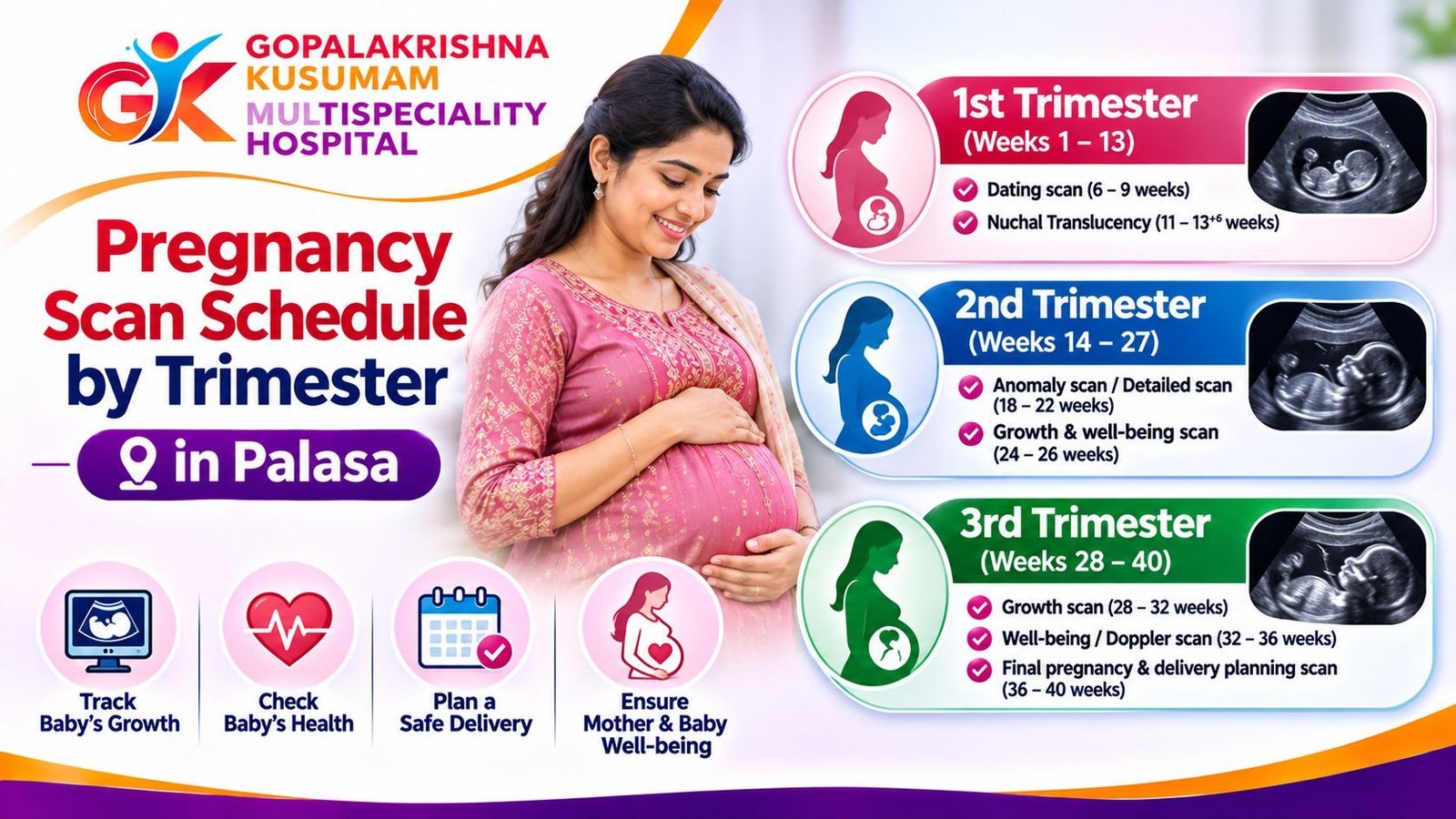
Pregnancy Scan Schedule by Trimester in Palasa
Pregnancy ultrasound scans: which scans and when
Quick answer: Most healthy pregnancies need at least two key ultrasound scans: a dating or NT scan at about 11 to 14 weeks, which confirms the due date, the number of babies and early development, and an anomaly scan at about 18 to 21 weeks, which checks the baby's organs and growth. Your doctor may also advise an early scan before 10 weeks if you have pain or bleeding, and growth scans later in pregnancy. The World Health Organization recommends at least one ultrasound before 24 weeks.
"When should I get my first scan?" is one of the first questions newly pregnant women in Palasa, Kasibugga and the villages of Srikakulam district ask, often alongside "How many scans are safe?" and "Is the scan in the third month really needed?". Family members may have their own ideas, and it is easy to feel confused.
This guide explains the main ultrasound scans in pregnancy, what each one checks, the usual timing, how to prepare and which warning signs should never wait for a scheduled appointment. Your obstetrician will tailor the plan to you, so use this as a guide for your conversation, not a fixed rulebook.
Why are ultrasound scans done in pregnancy?
An ultrasound scan uses sound waves, not X-rays, to create a picture of the baby in the womb. According to the NHS, ultrasound scans have no known side effects on mothers or babies and can be carried out at any stage of pregnancy (NHS: Ultrasound scans in pregnancy).
Scans help your doctor to:
- Confirm that the pregnancy is inside the womb (uterus) and that the baby's heartbeat can be seen.
- Work out how many weeks pregnant you are and your expected date of delivery.
- Find out if you are expecting twins or more.
- Check the baby's development and look for certain health conditions.
- Check the position of the placenta, the amount of fluid around the baby and the baby's growth later in pregnancy.
The World Health Organization's antenatal care recommendations say that one ultrasound scan before 24 weeks of pregnancy (an "early ultrasound") is recommended for pregnant women, to estimate the baby's age, detect anomalies and multiple pregnancies, and reduce unnecessary induction of labour for overdue pregnancies. WHO also recommends a minimum of eight antenatal contacts with a health provider during pregnancy.
First trimester (up to 13 weeks)
Early pregnancy scan (about 6 to 10 weeks, if advised)
Not every woman needs a scan in the first few weeks. Your doctor may advise an early scan if:
- You have bleeding or spotting, or pain in the lower abdomen.
- You have had a miscarriage or an ectopic pregnancy before.
- You are unsure of the date of your last period.
- You conceived with fertility treatment, or have certain medical conditions.
This scan confirms that the pregnancy is in the right place, checks for the baby's heartbeat and helps date the pregnancy. In the very early weeks, a scan through the vagina (transvaginal scan) may give a clearer picture; it is a routine method and is not harmful to the pregnancy.
Dating and NT scan (about 11 to 14 weeks)
This is one of the most important scans of pregnancy, and many women know it as the "third-month scan" or "NT scan". The NHS says the dating scan is usually offered at around 10 to 14 weeks of pregnancy (NHS: 12-week scan). It is used to:
- Confirm how many weeks pregnant you are and set your due date.
- See if you are expecting more than one baby.
- Check that the baby is growing in the right place and look at early development.
- Measure the fluid at the back of the baby's neck, called nuchal translucency (NT). Together with a blood test, this forms a screening test for conditions such as Down's syndrome.
Timing matters for the NT measurement, which can only be done within a specific window, so try not to delay this appointment. Screening tests estimate the chance of a condition; they do not give a definite diagnosis. If a screening result is high-chance, your doctor will explain the options for further tests.
Second trimester (14 to 27 weeks)
Anomaly scan (about 18 to 21 weeks)
Often called the "fifth-month scan", the mid-pregnancy or anomaly scan looks at the baby in detail. According to the NHS, it is usually done between 18 and 21 weeks and checks for a number of physical conditions, the baby's growth, the placenta and blood flow (NHS: 20-week screening scan). The sonographer or doctor examines the baby's head, brain, face, spine, heart, abdomen, kidneys, arms and legs.
Some conditions can be seen more clearly than others, so a scan cannot find every problem. If something needs a closer look, you may be asked to come back for a repeat scan or be referred for further tests.
Third trimester (28 weeks to delivery)
Growth and well-being scans (if advised)
Not every pregnancy needs a routine scan in the last three months. Your doctor may advise one or more growth scans if:
- Your bump seems smaller or larger than expected for the stage of pregnancy.
- You have high blood pressure, diabetes, anaemia or another medical condition.
- You are expecting twins.
- The placenta was found to be low-lying in an earlier scan.
- The baby's movements have reduced.
These scans check the baby's growth, the amount of fluid around the baby, the position of the baby and the placenta, and sometimes blood flow using a Doppler scan.
A simple scan timeline
- About 6 to 10 weeks: early scan, only if your doctor advises it.
- About 11 to 14 weeks: dating and NT scan.
- About 18 to 21 weeks: anomaly scan.
- After 28 weeks: growth scans, if your doctor advises them.
Bring all your scan reports and blood test results to every antenatal visit, and keep them safely in one file. They are very useful if you need to visit another hospital in an emergency.
How to prepare for a scan
- Ask whether you need a full bladder. For some early scans you may be asked to drink water beforehand; for others you will be asked to empty your bladder. Follow the instructions you are given.
- Wear loose, two-piece clothing so your tummy can be uncovered easily.
- Carry your previous reports and your antenatal card.
- Allow enough time. A scan usually takes around 20 to 30 minutes, according to the NHS, and may take longer if the baby is in an awkward position.
- Eat normally unless you have been asked to fast for a blood test on the same day.
Is the baby's sex told during the scan?
No. In India, finding out or disclosing the sex of the baby before birth is illegal under the Pre-Conception and Pre-Natal Diagnostic Techniques (PCPNDT) Act, 1994. Scans are done only to check the health and growth of the mother and baby. Please do not ask the doctor or sonographer about the baby's sex; they are not allowed to tell you.
How many scans are safe?
There is no fixed "safe number". According to the NHS, ultrasound has no known side effects on mothers or babies, but scans should still be done for a medical reason and as advised by your doctor, not for curiosity alone. Some women need more scans because of a medical condition or twins; others need only the routine ones.
Warning signs: do not wait for your next scan
Contact your doctor or go to hospital straight away if you have:
- Vaginal bleeding at any stage of pregnancy.
- Severe or one-sided pain in the lower abdomen, especially in early pregnancy, or pain in the shoulder tip.
- Leaking of fluid from the vagina.
- Severe headache, blurred vision or sudden swelling of the face, hands or feet.
- High fever, or burning and pain while passing urine.
- Fewer or no baby movements in the later months of pregnancy.
In an emergency, call 108 or 112.
Antenatal care in Palasa
Booking your pregnancy early, ideally in the first three months, makes it easier to plan scans at the right time. Government health facilities also provide free antenatal check-ups. Whichever facility you choose, regular visits, blood tests, iron and folic acid tablets as advised, and scans at the recommended times all work together to keep you and your baby safe. Our guide on why regular gynaecological check-ups matter explains more about routine women's health care.
At Gopala Krishna Kusuma Multispeciality Hospital's obstetrics and gynaecology department in Kasibugga, our doctors can guide you through your antenatal care and advise which scans you need and when. You can book an appointment online.
Frequently asked questions
When should the first pregnancy scan be done?
For many women, the first planned scan is the dating and NT scan at about 11 to 14 weeks. Your doctor may advise an earlier scan, at about 6 to 10 weeks, if you have pain or bleeding, a past miscarriage or ectopic pregnancy, or are unsure of your dates.
What is an NT scan and why is it important?
The NT (nuchal translucency) scan is done at about 11 to 14 weeks. It measures the fluid at the back of the baby's neck and, with a blood test, screens for conditions such as Down's syndrome. It also confirms your due date and the number of babies. It can only be done within a set window, so do not delay it.
When is the anomaly scan done?
The anomaly scan, sometimes called the fifth-month scan, is usually done at about 18 to 21 weeks of pregnancy. It checks the baby's organs, growth, the placenta and the fluid around the baby.
Are ultrasound scans safe for my baby?
According to the NHS, ultrasound scans have no known side effects on mothers or babies and can be done at any stage of pregnancy. Scans should still be done for a medical reason, at the times your doctor advises.
Do I need a full bladder for a pregnancy scan?
It depends on the scan. Some early scans need a full bladder to get a clearer picture, while others need an empty bladder. Follow the instructions given when you book your scan.
Can the scan tell me my baby's sex?
No. Finding out or revealing the baby's sex before birth is illegal in India under the PCPNDT Act. Scans are done only to check the health and growth of you and your baby.
Contact the hospital
For an obstetrics and gynaecology consultation at Gopala Krishna Kusuma Multispeciality Hospital, 3B, 5c 431/3A, Jayaramachandrapuram road, Kasibugga, Padmanabhapuram colony, Shivaji Nagar, Palasa, Andhra Pradesh 532222, call +91 79008 08790, or visit our contact page for directions and other ways to reach us. In an emergency, call 108 or 112.
Hours: OPD Monday to Saturday, 9 AM to 9 PM; emergency services 24 hours.
Disclaimer: This article is for general information only and is not a substitute for professional medical advice, diagnosis or treatment. Please consult a qualified doctor about your own health.
Image credit: Harrison Keely, via Wikimedia Commons, CC BY 4.0; cropped and resized. Representative stock image; it does not show the hospital's patients, staff or premises.