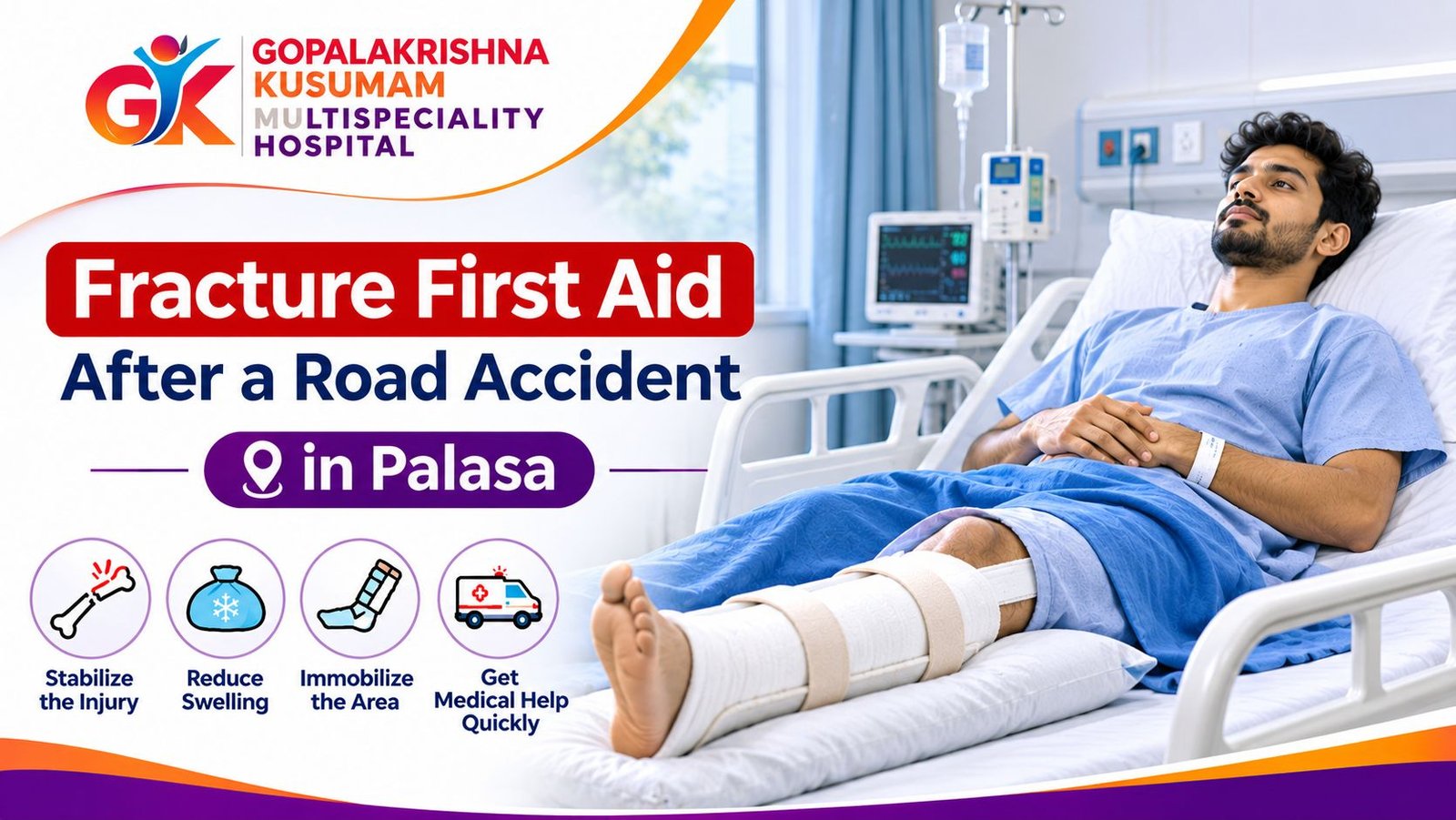
Fracture First Aid After a Road Accident in Palasa
Fracture first aid after a road accident: a practical guide
Quick answer: If you suspect a fracture after a road accident, first make the scene safe and call 108 or 112 if the person is badly hurt, bleeding heavily, unconscious, or has neck, back or head pain. Do not try to straighten the limb; keep it still with a simple support, control bleeding with gentle pressure, and get the person to a hospital for an X-ray and an orthopaedic assessment as soon as possible.
Two-wheelers, autos, tractors and buses share the roads around Palasa and Kasibugga every day, and National Highway 16 brings heavy through-traffic past the town. When a crash or a fall happens, the first few minutes are often confusing. Family members and passers-by want to help, but well-meant actions, such as pulling on an injured leg or rushing someone onto a bike pillion, can sometimes make an injury worse.
This guide explains, in plain language, how to recognise a possible fracture (broken bone), what first aid is safe while you wait for help, what to avoid, and what usually happens when you reach a hospital. It is general information to help you act calmly. It does not replace emergency services or a doctor's examination.
Why road accident injuries need careful handling
The World Health Organization notes that road traffic crashes kill about 1.16 million people worldwide each year and leave between 20 and 50 million more with non-fatal injuries, many of which cause disability (WHO road traffic injuries fact sheet). More than half of road deaths are among pedestrians, cyclists and motorcyclists, groups that share local roads every day.
A fracture is not always obvious. A person may walk a few steps on a cracked ankle, or feel only a dull ache in the wrist after breaking a fall with an outstretched hand. Other injuries, such as a head injury, internal bleeding or a spine injury, can be hidden behind a painful limb. That is why anyone who has been in a significant accident should be checked by a doctor, even if they say they feel fine.
Signs that a bone may be broken
According to the American Academy of Orthopaedic Surgeons, common signs of a fracture include pain, swelling, bruising and difficulty using the injured part (AAOS OrthoInfo: Fractures). Watch for:
- Severe pain at one spot that gets worse with movement or pressure
- Swelling or bruising that appears quickly after the injury
- A limb that looks bent, shortened, twisted or out of place
- Inability to bear weight on a leg, or to use a hand or arm normally
- A grinding or snapping feeling or sound at the time of injury
- A wound over the injured area with bone visible or suspected (an open fracture)
- Numbness, tingling, or a pale, cold hand or foot beyond the injury
Only an examination and usually an X-ray can confirm a fracture. If you are unsure, treat the injury as a possible fracture until a doctor says otherwise.
First aid steps while you wait for help
1. Make the scene safe
Before you help, check for traffic, fuel leaks or fire. Switch on hazard lights if a vehicle is involved and ask someone to direct traffic away. You cannot help the injured person if you become a second casualty.
2. Call for help early
Call 108 (ambulance) or 112 (emergency) if the person is unconscious, confused, breathing with difficulty, bleeding heavily, has pain in the neck, back or head, has an open wound over a suspected fracture, or has injuries to more than one part of the body. Give the exact location, including a nearby landmark on the Palasa–Kasibugga road or the highway kilometre stone if you can see one.
3. Do not move the person unless you must
If there is any chance of a neck or spine injury, keep the person still, with the head and neck supported in the position you found them. Move them only if they are in immediate danger, such as from fire or oncoming traffic.
4. Control bleeding
Press firmly on a bleeding wound with a clean cloth or bandage. If there is a bone end showing, do not push it back in; press around the wound instead and cover it loosely with the cleanest material available.
5. Keep the injured part still
Support the injured limb in the position you found it. For an arm, the person can often hold it against the body, or you can use a folded cloth or dupatta as a simple sling. For a leg, rolled towels or clothes placed on either side can stop it from rolling. If trained help is coming soon, there is usually no need to make a splint.
6. Reduce swelling and pain gently
A cold pack wrapped in cloth can be held on a closed injury for short periods. Do not put ice directly on skin. Remove rings, bangles, watches and tight footwear from the injured limb early, before swelling makes this difficult.
7. Keep the person warm and calm
Cover them with a shawl or blanket, reassure them, and stay with them. Shock can develop after a serious injury, so watch for pale, clammy skin, a fast pulse, confusion or faintness.
What not to do
- Do not try to straighten, pull or "set" a bent limb yourself.
- Do not let the person walk on a leg that may be broken.
- Do not give food or drink, in case surgery or sedation is needed later.
- Do not massage the injured area or apply oils, pastes or home remedies to an open wound.
- Do not tie a tight bandage that stops blood flow; check that fingers or toes stay warm and pink.
- Do not seat a badly injured person on a two-wheeler to "save time". Wait for an ambulance or use a vehicle where they can lie or sit supported.
Common fractures after road accidents and falls
Wrist and forearm fractures
These often happen when someone falls from a two-wheeler and puts out a hand. The NHS describes typical symptoms as pain, swelling, and the wrist or arm looking deformed (NHS: Broken arm or wrist). Many can be managed with a plaster cast or splint, while some need surgery to hold the bones in place.
Collarbone (clavicle) fractures
A shoulder hitting the road can break the collarbone. A sling usually supports the arm while the bone heals, but some displaced fractures need fixation.
Leg, ankle and foot fractures
Pedestrians and pillion riders are at risk of shin, ankle and foot injuries. Being unable to put weight on the leg is an important warning sign.
Hip fractures in older adults
In older family members, even a minor fall at home or while getting off a bus can break the hip, especially if the bones are thin (osteoporosis). Hip pain with inability to stand after a fall needs urgent medical attention.
Rib and pelvic injuries
These can cause pain with breathing or difficulty walking and may be linked to internal injuries, so they need prompt assessment.
What happens at the hospital
When you reach a hospital, the emergency or orthopaedic team will usually:
- Check breathing, circulation and consciousness first, then look for other injuries
- Examine the injured limb, its blood supply and nerve function
- Arrange X-rays, and sometimes other scans, to confirm the type of fracture
- Give pain relief and clean and dress any wounds
- Explain the treatment options for the specific fracture
Treatment depends on the bone involved, how badly it is displaced, the person's age and overall health. Options can include a sling, splint or plaster cast; manipulation of the bone back into position under anaesthesia; or surgery with plates, screws, rods or wires. Your doctor will explain why a particular option is recommended for you and what recovery is likely to involve.
Recovery and follow-up
Bones take several weeks or longer to heal, and the time varies with the bone, the person's age and health, and the type of treatment. Keep every follow-up appointment, as repeat X-rays help the doctor see whether the bone is healing in the right position. Physiotherapy is often recommended after the cast or splint comes off to restore movement and strength.
Contact a doctor promptly if, while in a cast, you notice increasing pain, numbness, swelling of fingers or toes, a bad smell, or a cast that feels too tight.
Preventing injuries on local roads
- Wear a properly fastened ISI-certified helmet on every two-wheeler trip, for rider and pillion.
- Use seat belts in cars and make sure children are seated safely.
- Avoid overloading autos and two-wheelers, and never ride after drinking alcohol.
- Take extra care at dawn and dusk, and during foggy winter mornings on the highway.
- At home, reduce fall risks for elders: good lighting, non-slip mats and a sturdy handrail help.
- With Diwali on 8 November 2026, keep children away from firecrackers on roads and terraces, and keep a bucket of water nearby.
Getting fracture care in Palasa and Kasibugga
If you or a family member in Palasa, Kasibugga or nearby towns such as Mandasa, Sompeta, Vajrapukotturu or Tekkali has had a fall or accident and you suspect a broken bone, do not wait for the pain to settle on its own. A timely examination helps rule out hidden injuries and lets the doctor plan the right treatment.
Our Orthopaedics department assesses bone, joint and injury problems. You can read more about why timely assessment matters in our article on how early diagnosis can help manage orthopaedic conditions. For a planned visit after the emergency phase, you can book an appointment online.
Frequently asked questions
How do I know if it is a fracture or just a sprain?
Both can cause pain, swelling and bruising, so it is often not possible to tell at home. A limb that looks deformed, severe pain at one spot, or being unable to bear weight suggests a fracture. A doctor's examination and an X-ray are usually needed to be sure.
Should I tie a splint myself after an accident?
If an ambulance is on its way, it is usually enough to keep the limb still and supported in the position you found it. If you must transport the person yourself, padding and a simple support that stops the limb from moving can help, but never try to straighten a bent limb.
When should I call 108 instead of taking the person myself?
Call 108 or 112 if the person is unconscious, has trouble breathing, is bleeding heavily, has neck, back or head pain, has bone visible through the skin, or has injured more than one part of the body. These situations need trained transport.
Can a fracture heal without surgery?
Many fractures heal well with a sling, splint or plaster cast. Others, especially displaced or unstable fractures, may need surgery. The orthopaedic doctor will advise based on the X-ray and your overall health.
How long does a broken bone take to heal?
It varies with the bone involved, the type of fracture, age and general health. Many fractures take several weeks to heal, with further time to regain strength. Follow-up X-rays help the doctor track healing.
What should I bring when visiting a hospital after an accident?
Bring any identity document, details of medicines the person takes, previous medical records if available, and any X-rays already taken. If police were involved, keep a copy of any paperwork you were given.
Contact the hospital
For an orthopaedic consultation at Gopala Krishna Kusuma Multispeciality Hospital, 3B, 5c 431/3A, Jayaramachandrapuram road, Kasibugga, Padmanabhapuram colony, Shivaji Nagar, Palasa, Andhra Pradesh 532222, call +91 79008 08790, or visit our contact page for directions and other ways to reach us. In an emergency, call 108 or 112.
Hours: OPD Monday to Saturday, 9 AM to 9 PM; emergency services 24 hours.
Disclaimer: This article is for general information only and is not a substitute for professional medical advice, diagnosis or treatment. Please consult a qualified doctor about your own health.
Image credit: ABORISADEADETONA, via Wikimedia Commons, CC0. Representative stock image; it does not show the hospital's patients, staff or premises.