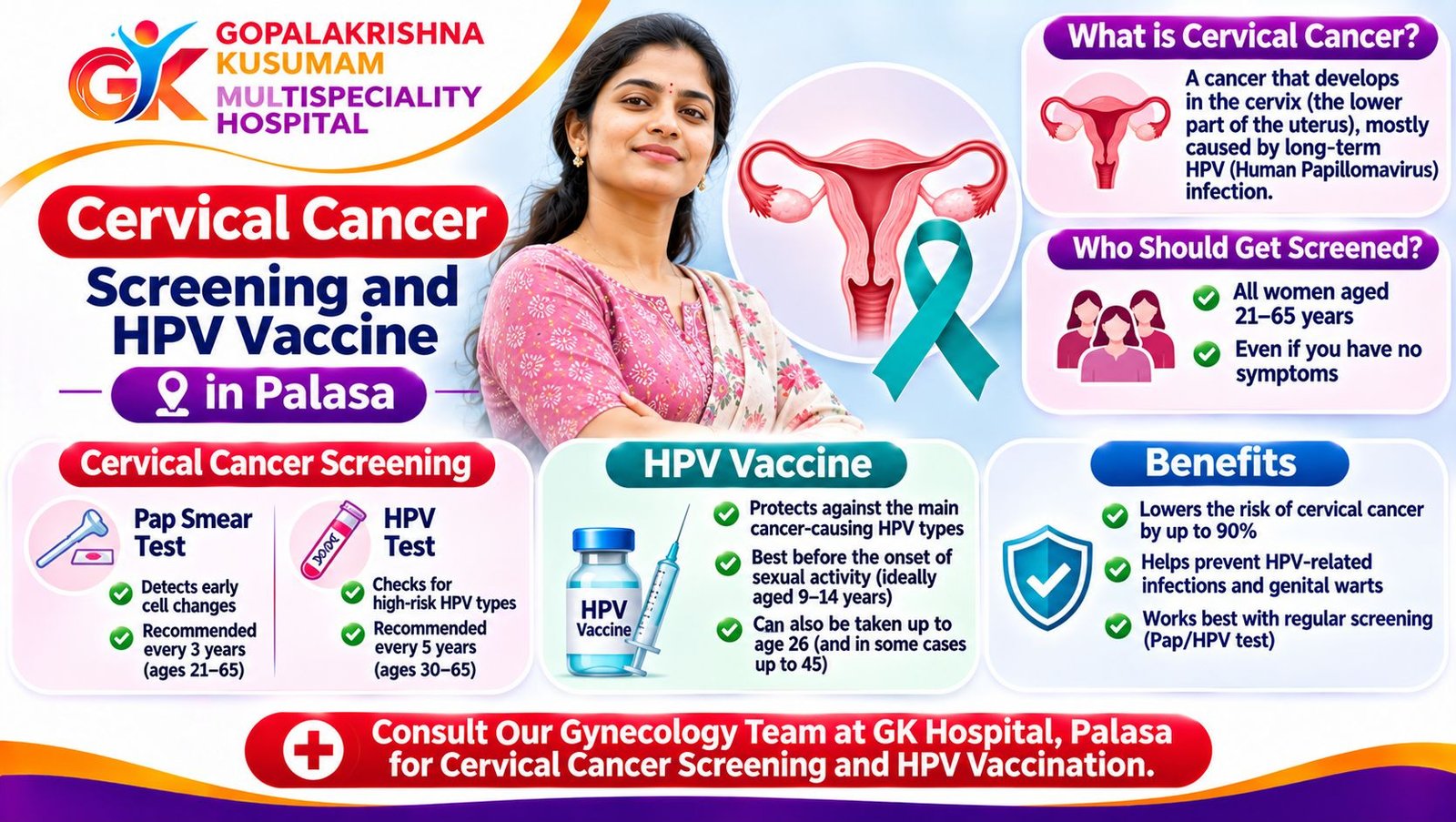
Cervical Cancer Screening and HPV Vaccine in Palasa
Cervical cancer screening and the HPV vaccine: a guide for women and parents
Quick answer: Almost all cervical cancer is caused by long-lasting infection with certain types of human papillomavirus (HPV). It can largely be prevented in two ways: HPV vaccination for girls before they become sexually active, and regular screening for women from the age of 30. The World Health Organization advises screening every 5 to 10 years from age 30 (every 3 to 5 years from age 25 for women living with HIV), even for women who have been vaccinated. Under India's national campaign, 14-year-old girls can get a free, single-dose HPV vaccine at government health facilities with parental consent. See a gynaecologist promptly for bleeding between periods, after sex or after menopause.
Cervical cancer prevention is in the news across Andhra Pradesh this year. The Union Health Ministry reported in September 2026 that more than 80 lakh HPV vaccine doses had been given under the National HPV Vaccination Campaign launched in February 2026, and that Andhra Pradesh had crossed 90 per cent coverage of its identified group of 14-year-old girls. With World Cervical Cancer Elimination Day on 17 November, now is a good time for families in Palasa, Kasibugga and across Srikakulam district to check two things: whether their daughters have been vaccinated, and whether the women in the family have had a screening test.
This guide explains what causes cervical cancer, how the HPV vaccine and screening tests work, what the warning symptoms are, and what to expect when you see a gynaecologist.
What is cervical cancer and what causes it?
The cervix is the lower, narrow part of the womb (uterus) that opens into the vagina. According to the World Health Organization (WHO), almost all cases of cervical cancer are caused by infection with high-risk types of HPV.
HPV is a very common infection that spreads through sexual contact. WHO notes that almost all sexually active people will be infected at some point, usually without any symptoms, and in most cases the body's immune system clears the virus on its own. In some women, however, the infection stays for years and slowly causes abnormal changes in the cells of the cervix, called precancer. WHO says it usually takes 15 to 20 years for these abnormal cells to turn into cancer, or 5 to 10 years in women with a weakened immune system, such as untreated HIV.
This long gap is the reason cervical cancer is so preventable: there is plenty of time to find and treat precancer before it ever becomes cancer.
Who is at higher risk?
Any woman who has ever been sexually active can develop cervical cancer. WHO lists several factors that increase the risk of HPV infection progressing:
- Infection with a high-risk HPV type that does not clear.
- A weakened immune system, especially HIV. WHO says women living with HIV are six times more likely to develop cervical cancer.
- Other sexually transmitted infections.
- Having many births or a first pregnancy at a young age.
- Long-term use of hormonal contraceptives.
- Smoking.
Having a risk factor does not mean a woman will get cancer, and women with no obvious risk factors should still be screened.
The HPV vaccine: what parents should know
WHO describes HPV vaccination of girls aged 9 to 14, before they become sexually active, as a priority, and says the vaccine is highly effective at preventing infection, cervical cancer and other HPV-related cancers. The licensed vaccines protect against HPV types 16 and 18, which WHO says cause around 76 per cent of cervical cancers. Depending on the national schedule, one or two doses may be given; people with a weakened immune system should ideally receive two or three doses.
Key points about India's national campaign, as described by the Union Health Ministry:
- Who: girls aged 14 years.
- What: a single dose of HPV vaccine, free of cost.
- Where: government health facilities, with vaccination sessions held under medical supervision.
- Consent: vaccination is voluntary and needs the parent's consent.
If your daughter is 14 and has not yet been vaccinated, ask your local ANM, ASHA worker, school or the nearest government health centre about the campaign. If your daughter is a different age, or if you have questions about whether the vaccine suits her, talk to a doctor. Like any vaccine, it can cause short-lived side effects such as a sore arm, and your doctor can explain these.
The vaccine does not treat an existing HPV infection and does not protect against every cancer-causing type, so vaccinated girls will still need screening when they grow up.
Cervical screening: tests for women aged 30 and above
Screening looks for HPV or precancerous changes before any symptoms appear. WHO notes that precancers rarely cause symptoms, which is why regular screening matters even for women who feel well and even for those who have been vaccinated. WHO advises:
- Screening with a high-performance test every 5 to 10 years from the age of 30.
- For women living with HIV, screening every 3 to 5 years from the age of 25.
- At minimum, two screening tests in a lifetime, by age 35 and again by age 45.
Common screening tests include:
- HPV test: checks a sample from the cervix for high-risk types of HPV. WHO notes that a sample collected by the woman herself can be as reliable as one taken by a health worker.
- Pap smear (cytology): a few cells are gently collected from the cervix and examined under a microscope for abnormal changes.
- VIA (visual inspection with acetic acid): a dilute vinegar solution is applied to the cervix and the health worker looks for colour changes. Under India's national programme for non-communicable diseases, government health centres, including Ayushman Arogya Mandirs, offer screening for common cancers, including cervical cancer, to women aged 30 to 65.
Pap smear screening, cervical cancer screening and HPV vaccination are listed among the services of the obstetrics and gynaecology department. The doctor will advise which test suits your age and health.
What happens during a screening test?
Many women delay screening because they feel shy or worry it will hurt. In reality, the test usually takes only a few minutes:
- You lie on an examination table, and a female staff member can be present if you wish.
- The doctor gently places a smooth instrument called a speculum in the vagina to see the cervix.
- A small brush or swab collects cells, or acetic acid is applied for VIA.
- Most women feel some pressure or mild discomfort, which settles quickly. Tell the doctor if you feel pain, and they can pause or adjust.
It is better not to book the test during your period. Ask the clinic whether you should avoid sex, vaginal creams or douching for a day or two before the test.
Regular gynaecology check-ups are also a good time to discuss periods, contraception and other concerns; our article on regular gynaecological check-ups for women's health covers this in more detail.
What if the screening result is abnormal?
An abnormal result does not mean you have cancer. In most cases it means HPV or precancerous changes have been found, which is exactly what screening is designed to catch. WHO explains that the next step is usually a closer look at the cervix, and that treatment of precancer is a simple and effective procedure that is usually quick. Options include thermal ablation or cryotherapy (destroying the abnormal cells with heat or cold) or removing the abnormal area with a small electric loop. The doctor will explain the plan, the benefits and the possible risks, and when to repeat the test.
Warning symptoms that need a gynaecologist's check
Early cervical cancer may cause no symptoms at all. WHO advises women to see a health professional if they notice:
- Unusual bleeding between periods, after menopause, or after sexual intercourse.
- Increased or foul-smelling vaginal discharge.
- Persistent pain in the back, legs or pelvis.
- Weight loss, tiredness or loss of appetite.
- Vaginal discomfort, or swelling in the legs.
These symptoms are often caused by other, less serious conditions, but they should always be checked. WHO notes that cervical cancer found at an early stage can be treated successfully, so do not wait for symptoms to become severe.
Frequently asked questions
My daughter is 14. Where can she get the free HPV vaccine?
Under the National HPV Vaccination Campaign, 14-year-old girls can get a free single dose at government health facilities, with a parent's consent. Ask your local ANM or ASHA worker, the school, or the nearest government health centre about session dates.
Do I need cervical screening if I feel completely healthy?
Yes. Precancerous changes rarely cause symptoms, so screening is meant for women who feel well. WHO advises screening every 5 to 10 years from age 30, or every 3 to 5 years from age 25 for women living with HIV.
If my daughter has had the HPV vaccine, will she still need screening later?
Yes. WHO says regular screening is still important for vaccinated women, because the vaccine does not protect against every cancer-causing HPV type. She should start screening at the age her doctor or the national programme advises.
Is a Pap smear test painful?
Most women feel only pressure or mild discomfort for a minute or two. Relaxing your muscles and telling the doctor how you feel helps. You can ask for a female staff member to be present during the examination.
Does a positive HPV test mean I have cancer?
No. HPV is very common and usually clears by itself. A positive test means the doctor will look more closely at the cervix and, if precancerous changes are found, treat them before they can turn into cancer.
Contact the hospital
For an obstetrics and gynaecology consultation at Gopala Krishna Kusuma Multispeciality Hospital, 3B, 5c 431/3A, Jayaramachandrapuram road, Kasibugga, Padmanabhapuram colony, Shivaji Nagar, Palasa, Andhra Pradesh 532222, call +91 79008 08790, or visit our contact page for directions and other ways to reach us. In an emergency, call 108 or 112.
Hours: OPD Monday to Saturday, 9 AM to 9 PM; emergency services 24 hours.
Disclaimer: This article is for general information only and is not a substitute for professional medical advice, diagnosis or treatment. Please consult a qualified doctor about your own health.
Image credit: Abdsomod, via Wikimedia Commons, CC0. Representative stock image; it does not show the hospital's patients, staff or premises.