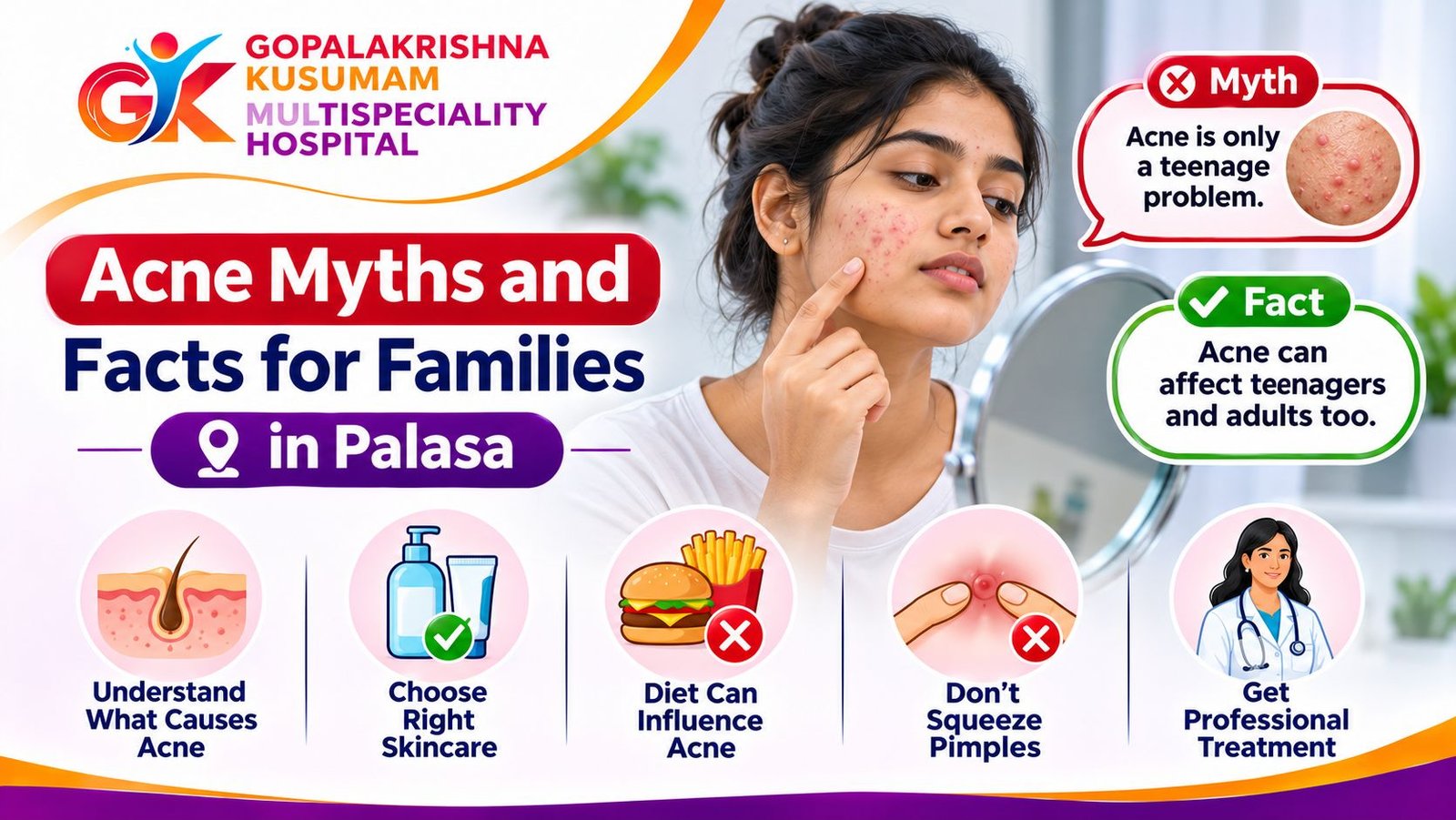
Acne Myths and Facts for Families in Palasa
Acne myths and facts: what really helps
Quick answer: Acne is not caused by dirty skin, and scrubbing, toothpaste or lemon juice will not clear it. It develops when hair follicles in the skin get blocked with oil and dead skin cells, often because of hormone changes, and bacteria then cause inflammation. Gentle twice-daily washing, non-greasy products, not squeezing spots and treatment used consistently for several weeks help most people. See a dermatologist if acne is painful, leaving marks or scars, or not improving.
Pimples are one of the most common skin problems, and many families across Palasa, Kasibugga and Srikakulam district deal with them. School and college students worry about them before exams and functions, young working adults try product after product, and many women notice breakouts around their periods or in their twenties and thirties. Along with the spots comes a flood of advice from friends, relatives and social media: "stop eating oily food", "apply toothpaste overnight", "wash your face five times a day", "it will go after marriage".
Some of this advice is harmless, but some of it delays proper treatment or even makes acne worse. In this guide we look at the most common acne myths, what the evidence actually says, and simple habits that help, based on guidance from the NHS and the American Academy of Dermatology.
What actually causes acne?
Our skin has tiny hair follicles, each connected to an oil gland. Acne happens when these follicles become blocked with excess oil (sebum) and dead skin cells. Bacteria that normally live on the skin can then grow in the blocked follicle and cause redness, swelling and pus.
According to the NHS, common triggers include:
- Changes in hormone levels, such as during puberty, periods, pregnancy and menopause.
- Some medical conditions, including hormonal conditions in women.
- Certain medicines.
- Greasy products used on the skin or hair.
Acne can show up as whiteheads, blackheads, red bumps (papules), pus-filled spots (pustules) and, in more severe cases, deep painful lumps (nodules and cysts) that can leave scars. It most often affects the face, chest and back.
Myth 1: "Acne is caused by dirty skin"
Fact: Acne is not a sign that you are unclean. Blackheads look dark because the oil and skin cells in the pore change colour when exposed to air, not because they are full of dirt. Washing more often does not remove the cause, which lies inside the follicle.
Myth 2: "Scrub hard and wash many times a day"
Fact: Over-washing and scrubbing irritate the skin and can make acne worse. The NHS advises washing the skin twice a day with a gentle cleanser, and not scrubbing. Rough face scrubs, harsh soaps and washing with very hot water can all leave skin red and irritated. After sweating, for example after a hot bus journey or field work, a gentle rinse is enough.
Myth 3: "Pimples only happen to teenagers"
Fact: Acne is most common in the teenage years, but it can start or continue well into adulthood, especially in women. The American Academy of Dermatology lists "acne will clear on its own once the teenage years are over" as a myth. Adult acne in women can sometimes be linked to hormonal conditions such as polycystic ovary syndrome (PCOS), particularly when it comes with irregular periods or extra facial hair. If that sounds familiar, mention it to your doctor.
Myth 4: "Oily food and sweets cause acne"
Fact: The link between diet and acne is more complicated than "oily food causes pimples". No single food causes acne in everyone. The American Academy of Dermatology notes that eating certain foods may worsen acne in some people: some research suggests that diets high in sugar and refined carbohydrates, and possibly milk, may worsen acne in some people, but the evidence is still developing. A balanced diet with vegetables, fruit, dals and enough water is good for overall health. If you notice that a particular food seems to trigger your breakouts, it is reasonable to cut down on it, but do not follow extreme diets in the hope of curing acne.
Myth 5: "Squeezing a pimple makes it go away faster"
Fact: Squeezing and picking push the contents deeper into the skin, increase swelling and can lead to infection, dark marks and permanent scars. The NHS specifically advises not to pick or squeeze spots. Keep your hands away from your face, and do not let anyone "clean out" your pimples with pins or needles at home.
Myth 6: "Toothpaste, lemon or garlic will dry out a pimple overnight"
Fact: Toothpaste, lemon juice, raw garlic, baking soda and similar home remedies are not acne treatments. They can burn and irritate the skin, especially on sensitive or brown skin, and may leave dark patches that last longer than the pimple itself. Treatments that have evidence behind them, such as products containing benzoyl peroxide or salicylic acid, are a safer first step; a pharmacist or doctor can guide you.
Myth 7: "Sun and tanning clear acne"
Fact: The American Academy of Dermatology lists this as a myth. A tan may hide redness for a short time, but sun exposure does not treat acne and can darken acne marks, which is a common worry for people with brown skin. Some acne treatments also make the skin more sensitive to the sun. Use a non-greasy sunscreen and shade, a cap or an umbrella in the strong coastal sun.
Myth 8: "Any cream from the medical shop will do"
Fact: Be very careful with creams bought without a prescription, especially "mixed" creams or fairness creams that contain steroids. Steroid creams applied to the face for long periods can cause acne-like breakouts and other skin damage, and acne often flares when they are stopped. Never use a steroid cream on acne unless a doctor has specifically prescribed it for you.
Myth 9: "Acne treatment does not work for me"
Fact: Most acne treatments take time. Many people stop after a week or two because they see no change, then decide nothing works. In reality, treatment needs to be used regularly for several weeks before improvement shows, and the American Academy of Dermatology notes that once acne clears, a maintenance plan is usually needed to keep it under control. If one treatment has not helped after a fair trial, a dermatologist can suggest other options.
Myth 10: "Acne is just cosmetic and not worth a doctor's visit"
Fact: Acne can cause pain, scarring and dark marks, and the NHS notes that it can also affect mental health, leading to anxiety, low mood and low self-esteem. Treating acne early can help prevent it from becoming more severe and reduce the risk of scars. Seeking help for acne is a sensible health decision, not vanity.
Simple daily habits that help
- Wash your face twice a day with a mild cleanser and lukewarm water, and pat it dry with a clean towel.
- Choose skin-care, sunscreen and make-up products labelled "non-comedogenic" or "oil-free", and remove make-up before sleeping.
- Keep hair oil away from the forehead and face. If you oil your hair, wash it off the hairline and avoid sleeping with oily hair on your face.
- Change your pillowcase and face towel regularly, and do not share towels.
- Wear loose, breathable cotton clothes if you get acne on your chest or back, and change out of sweaty clothes soon after work or exercise.
- Clean your mobile phone screen, which touches your cheek many times a day.
- Use treatments as directed, and give them time to work.
What treatments can a dermatologist offer?
For mild acne, a pharmacist may suggest products containing benzoyl peroxide or salicylic acid. For moderate or severe acne, or acne that has not responded, a dermatologist can prescribe stronger treatments after examining your skin. According to the NHS, these can include medicines applied to the skin, such as retinoids and antibiotic gels, and tablets such as certain antibiotics, hormonal treatment for some women, or isotretinoin for severe acne. Prescription acne medicines need medical supervision; some are not safe in pregnancy, so always tell your doctor if you are pregnant or planning a pregnancy.
A dermatologist can also advise on acne marks and scars once the active acne is under control.
When should you see a skin doctor?
Consider booking a consultation if:
- You have many spots, or deep, painful lumps under the skin.
- Your acne is leaving dark marks or scars.
- You have tried over-the-counter products regularly for a few weeks without improvement.
- Acne started suddenly in adulthood, or comes with irregular periods, extra facial hair or weight changes.
- A spot becomes hot, very swollen and painful, which may be a sign of skin infection.
- Acne is affecting your confidence, mood or daily life.
At Gopala Krishna Kusuma Multispeciality Hospital's dermatology department in Kasibugga, our doctors can assess your skin and suggest a treatment plan suited to you. You can book an appointment online.
Frequently asked questions
Does oily food cause pimples?
Not directly. No single food causes acne in everyone. Some research suggests that diets high in sugar and refined carbohydrates, and possibly milk, may worsen acne in some people. A balanced diet is good for your skin and health, but strict diets alone will not clear acne.
Can I apply toothpaste on a pimple?
It is better not to. Toothpaste is not made for skin and can cause burning, irritation and dark marks, especially on brown skin. Products containing benzoyl peroxide or salicylic acid are safer first options; ask a pharmacist or doctor which is suitable for you.
How long does acne treatment take to work?
Most acne treatments need to be used regularly for several weeks before you see improvement. Once acne clears, a maintenance plan is usually needed to stop it coming back. If there is no change after a fair trial, see a dermatologist for other options.
Is acne in adult women linked to hormones?
It can be. Hormone changes around periods, pregnancy and menopause can trigger acne, and hormonal conditions such as polycystic ovary syndrome (PCOS) can also play a part. If adult acne comes with irregular periods or extra facial hair, mention this to your doctor.
Will acne scars go away on their own?
Dark marks left after pimples often fade slowly over months, especially if you protect your skin from the sun and avoid picking. True scars, such as small pits, usually do not disappear on their own. Treating acne early reduces the risk of scarring, and a dermatologist can advise on options for scars.
Is acne contagious?
No. Acne cannot spread from one person to another by touch or by sharing a room. However, it is still a good idea not to share towels, make-up or pillowcases for general skin hygiene.
Contact the hospital
For a dermatology (skin) consultation at Gopala Krishna Kusuma Multispeciality Hospital, 3B, 5c 431/3A, Jayaramachandrapuram road, Kasibugga, Padmanabhapuram colony, Shivaji Nagar, Palasa, Andhra Pradesh 532222, call +91 79008 08790, or visit our contact page for directions and other ways to reach us. In an emergency, call 108 or 112.
Hours: OPD Monday to Saturday, 9 AM to 9 PM; emergency services 24 hours.
Disclaimer: This article is for general information only and is not a substitute for professional medical advice, diagnosis or treatment. Please consult a qualified doctor about your own health.
Image credit: Shixart1985, via Wikimedia Commons, CC BY 2.0; cropped and resized. Representative stock image; it does not show the hospital's patients, staff or premises.